Saturday, August 07, 2004

A “sensitive” war on terror?

All Allies, All the Time
Kerry puts the cart before the horse.


NRO


In one of my favorite episodes of M*A*S*H, Hawkeye and Trapper John were desperate to procure a medical incubator. They found their way to a corrupt supply sergeant who had three. The sergeant explained that he couldn't give the docs one of his incubators because, if he did, then he wouldn't have three anymore. He'd only have two, and two is worse than three.


This seems like the perfect metaphor for the "Kerry Doctrine." With the constant promises from almost every speaker at the Democratic convention that a President Kerry would create "strong alliances" as his backdrop, John Kerry declared this week that he will pursue a "more sensitive war on terror that reaches out to other nations and brings them to our side."

You know some Kerry handlers cringed when the word "sensitive" slipped out of Kerry's mouth. "Sensitive" isn't one of the adjectives most people want describing America's war on terrorism. It's like promising weapons systems "softer than a baby's bottom."

Regardless, for Kerry the vital issue is playing nicely with others. The New Republic's Peter Beinart recently wrote, "Intellectually, Kerry knows he must show he'd go after the terrorists with a vengeance. But that's not where his heart lies. The topic that arouses his greatest passion — the one that has guided his entire career — is improving America's relations with the world." In his 1997 book, Kerry called for the creation of an "entirely new, multilateral code of behavior." In 1993, during the confirmation hearings for Warren Christopher, Kerry called for "an all-out effort to strengthen international institutions." Two years later, Kerry broke with many Senate Democrats and voted against lifting the Bosnian arms embargo, mostly because he wanted Europeans to like us. The Washington Post reported that when Bill Clinton called America the "indispensable nation" in his second inaugural address, Kerry lamented Clinton's "arrogant, obnoxious tone."

And, Beinart notes, "even the 1991 Gulf war, which Kerry's aides now cite as a model of multilateral cooperation, struck him as suspiciously unilateral at the time." Back then, Kerry said, the anti-Saddam coalition "lacks a true United Nations collective security effort, with the full measure of international cooperation and burden-sharing."

This is all consistent with liberal rhetoric for the last three years. How many times have we been told that George W. Bush "squandered" the good will of the world "community" after 9/11? The assumption behind all of this seemed to be that anything which cost America the support of allies like France or Germany was, in effect, too costly. In other words, the means — "strong alliances" — are more important than the ends — winning the war on terror, toppling Saddam, and so forth. Listening to these folks, one gets the sense that America's greatest foreign-policy triumph was to get sucker-punched on 9/11 because it resulted in sympathetic newspaper headlines in Paris and Berlin.

Consider Kerry's seemingly final explanation for why he voted for a war he now condemns Bush for waging. He says he wanted Bush to have the authority to go to war in order to build up a mighty coalition to oust Saddam. But he says he didn't think Bush should actually go to war without such a coalition. Now that we know there weren't any obvious, imminently usable stockpiles of WMDs, that case looks better today than it did then. But Kerry deserves little credit on that score, since he too was certain that Saddam had such weapons.

Still, I agree that a mightier coalition than the one we had would have been nice. Indeed, if President Bush could have enlisted that indestructible ghost army from the third Lord of the Rings movie to do our fighting for us, that would have been really great. But, in the real world, Kerry's position puts the cart before the horse. Was the goal to topple Saddam and secure the WMDs, or was the goal to get a bunch of folks to do it with us? Indeed, Kerry thought the first Gulf War Coalition couldn't meet Kerry's standard.

Now, there is one caveat to the Kerry Doctrine of international hand-holding. If America is attacked, he says he wouldn't hesitate to respond with force. That's nice, I guess. But what else is he going to say? "If America is attacked, I promise to play Boggle in the Oval Office!" He makes it sound like he's the first president to have the courage to commit to a policy of retaliation to attacks. Has any president actually rejected such a policy?

Kerry promises "I will never give any nation or international institution a veto over our national security." Again, great. But no major candidate has ever promised to do otherwise. More importantly, the U.N. wouldn't need to have a veto over our national security with a President Kerry in office, since no situation obviously meets his standards for force except a direct attack. Kerry's like the sergeant from M*A*S*H who doesn't care what the incubators are supposed to be used for, so long as they're never used. For Kerry, no goal is worth losing allies, because keeping allies is Kerry's only goal.


Copyright (c) 2004 Tribune Media Services


Wednesday, August 04, 2004

VIET VETS LAUNCH ANTI-KERRY TV AD, BOOK

The new book UNFIT FOR COMMAND


see the video,

reveals dozens of shocking eyewitness accounts of questionable Kerry actions in Vietnam. Author John O'Neill, the man who took over John Kerry's Swift Boat, and co-author Jerome Corsi, Ph.D., have uncovered the bizarre truth behind Kerry's three Purple Hearts, his Bronze and Silver Stars, and the real reason Kerry served only four months in Vietnam.


Tuesday, August 03, 2004

John Kerry’s Future Terrorist Address

If there’s a new attack, what will Kerry say? It’s not hard to guess.


NRO


From a speech delivered by Sen. John Kerry during an appearance in lower Manhattan, October 18, 2004:


My fellow Americans.

For several days, I have refrained from speaking publicly about the events that led to last week's devastating terrorist attacks on the Stock Exchange here in New York and at the World Bank in Washington.


But now, I can no longer remain silent.

All of us support the president in the war on terrorism. We are united — as we have always been united — against those who would do us harm.

But we have now learned that last week's attacks — and the hundreds of deaths that resulted from them — could have been prevented.

We have learned that in June and July of this year, our government arrested senior al Qaeda terrorists in Pakistan.

U.S. agents seized computers filled with information about the attacks that took place last week.

The information was very detailed. The terrorists had studied every aspect of the Stock Exchange and the World Bank.

They knew how many people walked by each building at every minute of every day.

They knew the buildings' structures. They knew their weak points.

They knew which type of explosives would do the most damage.

All of that information — and much, much more — was contained in those computers captured in Pakistan.

And yet, did the president put the nation on alert?

Did he move heaven and earth to guard those buildings, to re-route traffic around them, to warn people of danger?

The answer, sadly, is no.

Administration officials say they did not act because the information was "old."

Some of it, they say, dated back before September 11.

One official even told the Washington Post, "There was nothing that we heard that was new. Why raise the alert level?"

In the days after September 11, 2001, we all asked why our government didn't "connect the dots" of intelligence pointing toward those terrorist attacks.

We thought our leaders had learned some lessons.

Now, we discover that they did not.

With these new attacks, we discover that there weren't just dots pointing toward the Stock Exchange and the World Bank.

There was a fully formed, richly detailed road map, telling our government just where — and how — the terrorists planned to strike.

And our government did nothing.

My friends, that should never, ever happen again.

As a candidate for president, I will not comment on the bipartisan impeachment proceedings begun by my colleagues in the House. They have a solemn duty to perform under very difficult circumstances.

I will only say that we have an opportunity to choose real leadership on November 2. And now — more than ever — we know what we must do.


Monday, August 02, 2004

St. Paul's Mayor Backs Bush

St. Paul Mayor Randy Kelly broke Democratic
Party ranks on Sunday to announce his support for President Bush's
re-election.


read more,


"George Bush and I do not agree on a lot of issues," Kelly
said in a statement.


"But in turbulent times, what the American
people need more than anything is continuity of government, even
with some imperfect policies."


Saturday, July 31, 2004

Why should John Edwards or anyone else want to be vice president?

The Insignificant Office


By Walter Berns

One of the men who held the post spoke of it as "the most insignificant office" ever contrived by the wit of man, and the men who wittingly contrived it — I mean, of course, the Framers of the Constitution — may have been of the same opinion. At least, they said nothing whatever about the qualifications of those who were to hold the office; unlike presidents and members of the House and Senate, vice presidents — so far as the Constitution is concerned — may be of any age and any nationality.


But the vice presidency is taken more seriously today than it apparently was by the Framers. The reason for this has nothing to do with the office itself — after all, its powers are almost nonexistent — and much to do with a presidential candidate's chances of winning an election. Interestingly enough, the reason the Framers created the office in the first place had something to do with — in fact, had only to do with — the election of the president.

The Framers had a hard time settling on the method by which the president was to be chosen. It was proposed that the president be chosen by the national legislature; by a part of the legislature; by state governors; by popular vote of the people; by electors appointed by the state legislatures, the national legislature, or in districts within the states; or by the people directly. But there were objections to each of these methods. A chief executive chosen by the Congress would make him its agent, which would be a violation of the principle of the separation of powers. If by state governors, "the executive thus chosen will not be likely to defend with becoming vigilance and firmness the National rights against State encroachments" (as James Madison wrote in his notes about the argument put forward by Edmund Randolph at the Convention in 1787).

By popular vote of the people? George Mason of Virginia "conceived it would be as unnatural to refer the choice of a proper character for chief Magistrate to the people, as it would, to refer a trial of colours to a blind man." Besides, said Hugh Williamson of North Carolina, "the people will be sure to vote for some man in their own State, and the largest State will be sure to succeed."

By electors appointed by the state legislatures? This proposal engendered no discussion whatever; put to the vote, only Maryland and Delaware favored it. "We seem," said Elbridge Gerry of Massachusetts, "to be entirely at a loss on this head." Indeed they were. As Madison said, "there are objections against every mode that has been, or perhaps can be proposed."

What is of interest here is that during the entire course of the debate — which began in May when Randolph introduced the so-called Virginia Plan for the Constitution and continued for over three months — no mention was made of a vice president.

This was not the result of oversight. The convention was aware of the necessity to provide for the case of the president's removal, death, or resignation. Thus, in its report of August 6, the Committee of Detail recommended that in such an event "the powers and duties of his office" be exercised by the president of the Senate. The office of vice president did not make its appearance until September 4 when, in its report, the Committee on Unfinished Parts recommended the establishment of the electoral college.

As adopted in the Constitution, the report provided that the electors were to vote for two people, "of whom one at least shall not be an Inhabitant of the same State with themselves," and "the Person having the greatest Number of Votes shall be the President, if such Number be a Majority of the whole Number of Electors appointed.... In every case, after the Choice of the President, the Person having the greatest Number of Votes of the Electors shall be Vice President."

A careful consideration of this provision reveals why we have a vice president. Each elector was given two votes, both to be cast for president (it was not until the adoption of the 12th Amendment in 1804 that electors were required to cast one vote for president and the other for vice president). Why two votes? Because, if each elector had one vote, and if he cast it for "an Inhabitant of the same State with [himself]," no one would win an electoral college majority and the choice of the president would devolve upon the Senate (subsequently changed to the House of Representatives).

But give the electors two votes each and the result would likely be the same. That is because, without a second office to fill, they would have reason to "throw away" their second votes. Consider the situation that would have attended the selection of the first president had George Washington (everyone's first choice) not been a candidate. There were 69 electors casting a total of 138 votes for president. The number required for election was 35 ("a Majority of the whole Number of Electors appointed," not a majority of the ballots cast). If, as the Framers assumed, most electors were to cast their first votes for a favorite son, no one would win a majority, and the issue would turn on the second votes. How would they be cast? Would the Virginians, for example, having cast their first votes for Thomas Jefferson, cast their second for John Adams? Not likely. To do so might give Adams (Massachusetts' favorite son) the 35 votes needed for election. They would be more likely to cast them for, say, Daniel of St. Thomas Jenifer of Maryland or (except that he had been killed in a duel) Button Gwinnett of Georgia — someone for whom no other elector was likely to cast a second vote. In a word, to enhance the chances of their first choice, electors would be inclined to "throw away" their second votes.

The vice presidency was created to make it less likely that electors would do this. With two offices to fill, and knowing that the vice president would succeed to the office in the event of the president's death or removal, they would have reason to cast their second votes for the best man from some other state rather than for a nonentity. "Such an officer as vice-president was not wanted," said Hugh Williamson on September 7. "He was introduced only for the sake of a valuable mode of election which required two to be chosen at the same time."

The vice president's only constitutional duty is to preside over the Senate (and cast a vote only in the event it "be equally divided"); and he was given that assignment only because, as Roger Sherman put it, "he would [otherwise] be without employment." With little to do — Dick Cheney is an exception to this — most vice presidents have spent their time in office doing little, and the republic is none the worse off for the little they did. But nine of them succeeded to the presidency, a fact that John Kerry (we hope) remembered when choosing his running mate.


DEM'S MARINE MISFIRE

July 31, 2004 -- SCRANTON, Pa. — John Kerry's heavily hyped cross-country bus tour stumbled out of the blocks yesterday, as a group of Marines publicly dissed the Vietnam War hero in the middle of a crowded restaurant.


nypost.com


Kerry was treating running mate Sen. John Edwards and his wife, Elizabeth, to a Wendy's lunch in Newburgh, N.Y., for their 27th wedding anniversary — an Edwards family tradition — when the candidate approached four Marines and asked them questions.

The Marines — two in uniform and two off-duty — were polite but curt while chatting with Kerry, answering most of his questions with a "yes, sir" or "no, sir."

But they turned downright nasty after the Massachusetts senator thanked them "for their service" and left.

"He imposed on us and I disagree with him coming over here shaking our hands," one Marine said, adding, "I'm 100 percent against [him]."

A sergeant with 10 years of service under his belt said, "I speak for all of us. We think that we are doing the right thing in Iraq," before saying he is to be deployed there in a few weeks and is "eager" to go and serve.

The Marines — all of whom serve at nearby Stewart Air Force Base — wouldn't give their names.


Friday, July 30, 2004

Rushed speech, lost opportunity

By Thomas Oliphant, Globe Staff


boston globe


FOR REASONS he might like to explain, John Kerry last night raced through an acceptance speech that was way too long for a time slot he knew about for weeks.

Desperate to stay within the broadcast networks' paltry 60 minutes, Kerry stepped on his best thoughts and lines and blurred important proposals and distinctions, committing the sin of interfering with his own ability to communicate with an electorate eager to learn much more about President Bush's opponent.

At a Democratic convention planned to showcase a candidate and his basic approach to two huge situations -- a bogged-down military adventure in Iraq and a fragile economy -- Kerry obscured his presentation in a blizzard of hard-to-follow verbiage dictated by the clock.

Perhaps the public will let him off the hook, but the fact remains that Kerry essentially blew an opportunity he may not get again until the debates with Bush this fall. He and his advisers can and will argue that the cold facts of economic and foreign policy life will dominate political opinion in the weeks ahead; nevertheless, a golden opportunity slipped away.

It almost never happens, but Kerry appears to rank at the bottom of a short list of the most significant Democratic orators that was headed by (take your pick) running mate John Edwards and Illinois Senate candidate (and keynoter) Barack Obama and included the Rev. Al Sharpton and Senator Edward Kennedy.

Yesterday morning there were reports from Democratic and Kerry campaign officials that the speech remained roughly 20 minutes too long despite a process of thinking, writing, and editing that had been going on in earnest at least since his selection of Edwards on July 6.

At first it appeared that the process was achingly slow and dominated by a candidate determined to sketch out the basic outline and content of his speech alone with a yellow pad. With assistance, a body of text approaching 10,000 words was collected and then expanded upon by a campaign determined to add more material to show how "tough" Kerry intends to be in fighting terrorism.

Kerry was not delivering a practice State of the Union Message last night. He was giving a thematic overview. The purpose was not to make new proposals but to present himself as a public servant, an advocate of effective and honest conduct of a new kind of war, and a proponent of a more robust economy that will raise ordinary Americans' living standards.

In parts it was beautifully written (trees as "the cathedrals of nature"). In parts it was horrid -- the snappy salute at the outset and the distinctly nonpresidential announcement that "I'm John Kerry, and I'm reporting for duty."

Because Kerry was racing, the audience in the convention hall responded with its loudest noise to points about civil right and civil liberties dear to liberals' hearts but not central to Kerry's election strategy -- there will be a new attorney general, no assaults on the Constitution, and no partisan use of the American flag.

That's reassuring, but Kerry muffed an opportunity to hone great material into a powerful address. He and his campaign can do better than this, and his supporters have a right to demand that they do.


FOR REASONS he might like to explain, John Kerry last night raced through an acceptance speech that was way too long for a time slot he knew about for weeks.


Desperate to stay within the broadcast networks' paltry 60 minutes, Kerry stepped on his best thoughts and lines and blurred important proposals and distinctions, committing the sin of interfering with his own ability to communicate with an electorate eager to learn much more about President Bush's opponent.

At a Democratic convention planned to showcase a candidate and his basic approach to two huge situations -- a bogged-down military adventure in Iraq and a fragile economy -- Kerry obscured his presentation in a blizzard of hard-to-follow verbiage dictated by the clock.

Perhaps the public will let him off the hook, but the fact remains that Kerry essentially blew an opportunity he may not get again until the debates with Bush this fall. He and his advisers can and will argue that the cold facts of economic and foreign policy life will dominate political opinion in the weeks ahead; nevertheless, a golden opportunity slipped away.

It almost never happens, but Kerry appears to rank at the bottom of a short list of the most significant Democratic orators that was headed by (take your pick) running mate John Edwards and Illinois Senate candidate (and keynoter) Barack Obama and included the Rev. Al Sharpton and Senator Edward Kennedy.

Yesterday morning there were reports from Democratic and Kerry campaign officials that the speech remained roughly 20 minutes too long despite a process of thinking, writing, and editing that had been going on in earnest at least since his selection of Edwards on July 6.

At first it appeared that the process was achingly slow and dominated by a candidate determined to sketch out the basic outline and content of his speech alone with a yellow pad. With assistance, a body of text approaching 10,000 words was collected and then expanded upon by a campaign determined to add more material to show how "tough" Kerry intends to be in fighting terrorism.

Kerry was not delivering a practice State of the Union Message last night. He was giving a thematic overview. The purpose was not to make new proposals but to present himself as a public servant, an advocate of effective and honest conduct of a new kind of war, and a proponent of a more robust economy that will raise ordinary Americans' living standards.

In parts it was beautifully written (trees as "the cathedrals of nature"). In parts it was horrid -- the snappy salute at the outset and the distinctly nonpresidential announcement that "I'm John Kerry, and I'm reporting for duty."

Because Kerry was racing, the audience in the convention hall responded with its loudest noise to points about civil right and civil liberties dear to liberals' hearts but not central to Kerry's election strategy -- there will be a new attorney general, no assaults on the Constitution, and no partisan use of the American flag.

That's reassuring, but Kerry muffed an opportunity to hone great material into a powerful address. He and his campaign can do better than this, and his supporters have a right to demand that they do.


America, Recuse Thyself!

So the world's mad at us? Maybe we should just say goodbye


opinion journal


BY P.J. O'ROURKE
Sunday, May 30, 2004 12:01 a.m. EDT

John Kerry says America shouldn't cut and run. George Bush says America mustn't. But we don't have to retreat ignominiously from the war on terrorism and from our other international responsibilities and commitments; we can recuse ourselves. We can explain to the court of global public opinion that, because America possesses the largest economy, the widest network of business relationships, and the only effective military force on earth, we have too great a vested interest in world events to render fair and impartial judgment. On every issue of geopolitical adjudication, from 9/11 to the Kyoto Protocol on Climate Change, America is a jury of cops and crime victims. A change in venire has already been called for by noisy street protestors, France and suchlike. Let's accede to the pre-emptory challenge and go home.

The benefits will be immediate. We can cut $300 billion from our defense budget. This will be almost enough to pay for the aging baby boomers' prescription drug benefits, which can now include Levitra, Botox and medicinal cannabis.

America will enjoy cleaner air and less traffic congestion as oil goes to $200 a barrel due to chaos in the Middle East. A U.S. withdrawal from the Middle East will cause chaos, of course. Then again, a U.S. intervention in the Middle East has caused chaos already. And, during those periods of history when the U.S. was neither intervening in nor withdrawing from the Middle East, there was . . . chaos. The situation is akin to the famous complaint women have against men: failure to acknowledge that not every problem can be fixed. Sometimes the best thing is just a little sympathy. America had everyone's sympathy after the World Trade towers were attacked. We can get that sympathy back if we limit our foreign policy objectives to whining.


One thing to whine about will be the fate of Israel. Without American safeguards that nation is certain to be militarily attacked. To judge by previous Israeli wars, in 1948, 1956, 1967, 1973 and 1982, the result will be serious headaches for Israelis as the Knesset furiously debates the status of Jewish settlements outside Damascus and on the west bank of the Euphrates.
Elsewhere, however, Islamic fundamentalists will likely triumph. Is this necessarily a bad thing? Our own country was founded by people who, today, would be considered religious extremists. Perhaps a bond of fellow-feeling will grow between puritanical Muslims and heirs to American Puritanism. Maybe cultural exchanges of the old U.S.-Soviet type can build people-to-people-based peaceful coexistence such as we had during the Kissinger era of detente. Visiting America on fellowship programs, even the most fanatical members of al Qaeda will be moved by the story of the Salem witch trials and their pious outcome. And while Hester Prynne was not stoned to death, her crime may be said to have been treated with the letter, if not the spirit, of sharia law.

Meanwhile various unpopular rulers who have held onto power with American support will be forced to submit to the will of their people. Tony Blair comes to mind.

Other positive effects are to be expected. The United Nations, freed from superpower interference, will assume its rightful role exercising peacemaking functions--and getting plenty of exercise at it. Scores of belligerents, freed from superpower interference, will create opportunities for U.N. peacemaking functions such as sending numerous bureaucrats, functionaries, commissions and inspection teams to keep combatants too busy with meetings and paperwork to have time to fight.

A NATO alliance that does not include the U.S. will acquire a new sense of mission and purpose, especially in Gdansk, Istanbul and maybe Hamburg, when Russia resumes its historic quest for warm-water ports.

The threat of nuclear proliferation will abate as dangerous stockpiles of atomic weapons are quickly used up. The loss of life will be regrettable. But this will be counterbalanced by the welcome disappearance of long-standing international flashpoints when the India-Pakistan border is vaporized, Tehran disappears in a mushroom cloud, and whatever is left of the Korean Peninsula becomes reunited.

China will assume its proper role in the world. A booming China can be expected to concentrate on economic issues. Look for Beijing to create a "Greater East Asia Co-Prosperity Sphere," so to speak. And China won't have to bomb Pearl Harbor. There will be nothing there but cruise ships--all in mothballs as a result of $200-a-barrel oil.

America's protestors against globalization will be able to relax. An inward-looking America is bound to link military and diplomatic disengagement with higher trade barriers. There will be domestic political pressure to create jobs for the hundreds of thousands of returning military personnel, State Department employees, Peace Corps volunteers, network foreign-correspondents, etc. Unfortunately, the jobs will be mostly mowing lawns and taking care of the children of husband/wife lawyer couples, since a decreasing involvement with foreign affairs will lead to an increasing resentment of foreign immigrants. (At a theoretical level there may be no reason why Isolationism, Protectionism and Nativism should be conjoined. But we can hardly have Larry and Curly without Moe.) Yet in a sensitive, diverse 21st-century America, we probably will be spared past excesses. Perhaps we'll see the rise of an In-Klusive Klux Klan. Plus, an increase in the minimum wage will solve the problem of employment inequities.


And the best thing about Americans recusing ourselves from global entanglements is that we will be loved again. Imagine a world where American manners and mores set the standard almost everywhere, where American fashions, American ideas and American lifestyles are universally sought out and copied. A world where people avidly listen to American music, eagerly watch American TV and movies, and try to imitate Americans in every way. Imagine a world where the U.S.A. is so admired that people by the millions want nothing more than to come to America and recuse themselves from global entanglements.


Thursday, July 22, 2004

what the left thinks

Turning Tale


The new republic online,


DAILY EXPRESS
Turning Tale
by Martin Peretz


Post date: 07.21.04
[ A postscript was appended to this article on July 22. ]

he tale spun by former Ambassador Joseph Wilson that Iraq did not ever try to buy uranium yellowcake from Niger is now in the process of unraveling. And, of course, the phalanx of anti-war journalists is desperately trying to stop the bust-up. But it can't be done. The flying apart began with two stories in the Financial Times (London), one on June 28, the other on July 4. Relying on information ultimately sourced to three European intelligence services--none of them British and one of them that had monitored clandestine uranium smuggling to Iraq over three years--Mark Huband reported that the network also serviced or was to service Libya, Iran, China, and North Korea. A tell-tale element of the story is that the mines in Niger from which several thousand tons of uranium had been extracted and sold were owned by French companies. Apparently, after a time, they had abandoned the mines as economically unviable. But, as a counter-proliferation expert told Huband, this does not mean that extraction stopped. In any case, Lord Butler's altogether independent panel in the United Kingdom concluded that Tony Blair's claim about Hussein being in the market for uranium was "well-founded." These are the same claims made by George W. Moreover, the U.S. Senate report undercuts Wilson's very believability. I myself had wondered why the CIA had been so dumb--such dumbness is something to which we should have long ago become accustomed!--as to send a low-level diplomat to check on yellowcake sales from Niger to Iraq when it should have dispatched a real spook. Well, it turns out that a "real spook" had recommended him to her boss, that spook being Valerie Plame, who happens also to be Wilson's wife. He has long denied that she had anything to do with his going to Niger and that, alas, was a lie. It appears, in fact, that this is the sole reason he was sent. Still, in a lot of dining rooms where I am a guest here, there is outrage that someone in the vice president's office "outed" Ms. Plame, as though everybody in Georgetown hadn't already known she was under cover, so to speak. Under cover, but not really. One guest even asserted that someone in the vice president's office is surely guilty of treason, no less--an offense this person certainly wouldn't have attributed to the Rosenbergs or Alger Hiss, Daniel Ellsberg or Philip Agee. But for the person who confirmed for Robert Novak what he already knew, nothing but high crimes would do.

I confess: I do not like Sandy Berger; and I have not liked him since the first time we met, long ago during the McGovern campaign, not because of his politics since I more or less shared them then, but for his hauteur. He clearly still has McGovernite politics, which means, in my mind, at least, that he believes there is no international dispute that can't be solved by the U.S. walking away from it. No matter. Still, here's his story about the filched classified materials dealing with the foiled Al Qaeda millennium terrorist bombing plot from the National Archives: He inadvertently took home documents and notes about documents that he was not permitted to take from the archives; secondly, he inadvertently didn't notice the papers in his possession when he got home and actually looked at them; and, thirdly, he inadvertently discarded some of these same files so that they are now missing. Gone, in fact. One of his lawyers attributes this behavior to "sloppiness," which may better explain his career as Bill Clinton's National Security Adviser and certainly describes his presentation of self in everyday life. But it is not an explanation of his conduct in the archives or, for that matter, at home. Personnel at the archives actually noticed him stuffing his pockets with papers as he left, which is how the FBI found out about this bizarre tale in the first place. Inadvertence, then, doesn't do it either. Maybe Sandy wanted souvenirs from his career in the White House that was punctuated by so many catastrophes for the United States. Nonetheless, he has had ambitions tied to John Kerry's, ambitions that clash with those of Richard Holbrooke and Joe Biden, who decisively do not have McGovernite politics. But Berger did run the Kerry foreign policy team at the writing of the Democratic Party platform a few weeks ago (when the only opposition, easily pacified, came from a handful of Dennis Kucinich loyalists) and has been deeply involved in crafting how the candidate presents himself on these issues. So my question is: Did Berger, who knew that he was under scrutiny since last fall, alert Kerry to the combustible fact that he was the subject of a criminal probe by the Justice Department and the FBI? My guess is not. Kerry is far too smart, too responsible to have kept him around had he known. But if Kerry didn't know, it tells you a lot about Berger, too much, really. A more important question, of course, is: What was contained in the papers that Berger snatched? The answer to that question might answer another. Maybe Clinton's top national security aide didn't want others to see what they documented.

French President Jacques Chirac has let it be known that Israeli Prime Minister Ariel Sharon is not welcome as a guest in Paris. Mazel tov! Can you actually imagine Chirac putting out a genuine welcome mat for the Israeli leader who has shown that all of France's interventions in the area have brought nothing good: more of terror, more of Arafat, worst of all, more of Palestinian suffering, all to succor the illusion of French influence in the region. But this latest donnybrook between the two leaders focused not on the dispute with the Palestinians but about anti-Semitism in France itself. Chirac has for years been denying that the ugly phenomenon even exists. Finally, when day after day, evidence mounted that the country has not expelled the virus of Jew-hatred from the body-politic and that it is now becoming more malignant, even Chirac himself has had to sound the tocsin. And Sharon sounded it, as well, when this week he called on French Jews to make aliyah or "go up" to Israel. (Would that some Israeli leader had a quarter century ago called on the Jews of Argentina to immigrate.) This really got Chirac's goat. But not before he demonstrated in an off-hand remark that, for him, neither Jews nor Muslims, for that matter, are really genuinely French: "we are witnessing racial events involving our Jewish and Muslim compatriots. ... Sometimes just simple Frenchmen are attacked." This is an ugly dichotomy. But it is not new. After the terrorist bombing of the rue Copernic synagogue on October 3, 1980, Raymond Barre, the French prime minister, alluded to this "odious act which intended to strike Jews [and] struck innocent Frenchmen." Of course, Chirac and Barre are from the center-right and right where anti-Semitism has always nested. But such views are now a staple of the oh, so enlightened left, as well. French hatred of Jews now goes wall-to-wall. And French hatred of Israel, too. A few days ago, France went into a frenzy to mobilize the countries of the European Union at the UN to vote "yes" on the General Assembly resolution calling on Israel to take down the security barrier it is building against Palestinian terror. Many fatuous reasons were mustered to support this demand. But the real reason that France and some others oppose the fence is that it works.

A new book by Christopher Andersen will hit The New York Times bestseller list this week. It is called American Evita, and it is about Hillary Rodham Clinton. She pushed herself into a prime time, opening night spot at the Democratic convention after the Kerry folk had relegated her to just one in an "all-the-girls" appearance of the party's women senators, with Barbara Mikulski doing the speaking. How Rodham Clinton maneuvered herself out of this is hard to tell. But one clue is that the Democratic National Committee is still run by Clintonians. And, while we're mentioning arch names, there is Teresa Heinz Kerry, more than a bit on the haughty side herself. Heinz Kerry has certainly put John Edwards in his place in announcing that he is her husband's "second running-mate." This is fair warning of how she sees herself as first lady.

On the day that the 216th General Assembly of the Presbyterian Church (USA) voted to begin divesting its holdings in corporations that do business with and in Israel, there was a pitched street battle in and around Bethlehem. It was not a battle between Jews and Arabs or between Hamas and Fatah. It was a battle between Christians and Muslims. Bethlehem used to be a largely Christian city. It is, after all, where Jesus was born, so where the Church of the Nativity stands. Roman Catholics, Armenians, and Greek Orthodox have lived and flourished there since the first centuries of early Christianity. No longer. As soon as the Palestinian Authority took over in 1994, the Christians of Bethlehem began to leave, many in an understandable panic. For all its secular pretenses, the PA is a militant Muslim jihadist show. A Christian population that not so long ago stood at roughly 75 percent may now be as low as 30 percent. Many of them have come to the U.S. But American churches have averted their eyes from what is really tantamount to an expulsion of Christians not only from Bethlehem but from the Holy Land itself. The Presbyterians have also turned the other cheek by siding with those who torment their own. And they have disavowed Christian Zionism as a heresy. Of course, there are only two and a half million Presbyterians in the U.S.--way down from what once made up this proud church. Moreover, there is growing alienation between the political leadership of the church and lay believers, as there is in the Episcopal communion, much of this revolving around the implicit support of the clerisy for Palestinian terror.

Postscript, July 22

The Kerry campaign has accused the White House of having leaked Sandy Berger's troubles to the press, and I wouldn't be a bit surprised if it did. As The New York Times pointed out today (July 22), however, this would not at all have been illegal or even unusual. It smells nonetheless. But most recent news answers another question that I asked yesterday: Did John Kerry know that Berger was under investigation by the FBI and the Justice Department? As I surmised, neither Kerry nor his staff was at all "witty," as it is called in the intelligence trade, and they were caught completely off guard. Kerry was probably rip-shit. Nonetheless, he issued a gentlemanly, even statesmanlike, comment saying, "Sandy Berger is my friend, and he has tirelessly served this nation with honor and distinction. I respect his decision to step aside as an adviser to the campaign..." But Berger's behavior in clinging to his role as Kerry's foreign policy guru shows that he is anything but a friend. Hoping that the disgrace of pilfering from the National Archives what were actually documents with the very highest security coding would somehow pass unnoticed in public, Berger was even willing to put his candidate at risk. This is a distinction of sorts. But it is not at all honorable.


Monday, July 19, 2004

'YOU'RE GOING TO FIND US WORKING'


Kerry has missed more than 80% of Senate votes this year, the AP reports.


"So here's what we're going to fight for,

and we're going to fight for it every single day,

not just through this election,

but from the day we win until the day we raise our

hands and every day thereafter. You're not going

to have to look for us on vacation.

You're going to find us working for America."

--- Kerry Delivers Remarks At Campaign Event, Cleveland, OH, 7/7/04


Sunday, July 18, 2004

KERRY ON PREEMPTION, THEN AND NOW

Democratic presidential candidate John Kerry said Friday he would be willing to launch a pre-emptive strike against terrorists if he had adequate intelligence of a threat.
"Am I prepared as president to go get them before they get us if we locate them and have the sufficient intelligence? You bet I am," he said at a news conference at his Washington headquarters.


The Boston Globe, February 28: “Sen. John Kerry said President Bush's policy of “unilateral preemption” had failed to win the war on terror and only fueled anti-American anger worldwide.”

Kerry’s speech before the Council on Foreign Relations last December: “We have a President who has developed and exalted a strategy of war – unilateral; pre-emptive; and in my view, profoundly threatening to America’s place in the world and the safety and prosperity of our own society.”

Kerry on “Meet the Press” last December: “I did not buy into preemption … I thought that was wrong.” The doctrine of preemption the “most arrogant, inept, reckless and ideological foreign policy” in modern history.


GALLUP NEWS SERVICE

Most Americans Want Dick Cheney to Stay on GOP Ticket


Despite some "buzz" in recent weeks about the possibility of President George W. Bush dropping Dick Cheney from the Republican presidential ticket, there is little public support for such a change. A majority of Americans, including 7 in 10 Republicans, want Cheney to remain on the ticket, his favorable ratings are no lower now than they were earlier this year, and Cheney is actually less of a polarizing figure than is his boss, George W. Bush.

read more,


Saturday, July 17, 2004

Hang ten

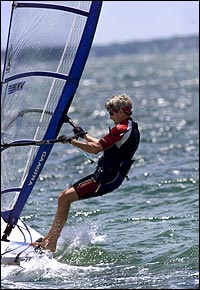
Democratic presidential candidate John Kerry kite surfs off the coast of Nantucket, Massachusetts. (AFP/Luke Frazza)


Cinema of cynicism

How did the irreverent prankster Michael Moore ever become a prominent media figure - much less the left's new hope for ousting US president George W Bush from power?


Following the Oscar he received for his gun culture documentary Bowling for Columbine, and the Palme D'Or at the Cannes Film Festival for his anti-Bush documentary Fahrenheit 9/11, Moore and his projects have been obsessively followed by the media. He was recently featured on the cover of Time magazine, while every aspect of the wheeling and dealing surrounding the distribution and rating of Fahrenheit 9/11 was documented to death (1).


When it was recently rumoured that Moore would make a documentary about UK prime minister Tony Blair, and then Moore denied the rumour, and then he suggested that perhaps he would make such a documentary after all, each of these inane developments was reported separately as though it were a significant news story (2).


What has Moore done to deserve this level of attention? There's no doubt that he's a smart operator when it comes to self-promotion, but that alone can't explain it. His critics have noted his tendency to exaggerate the forces that conspire to stop him from getting his message out to the public, for example his claim that the publisher HarperCollins tried to suppress his book Stupid White Men, and his claim that Disney - not to mention Moore's perennial adversary, 'someone connected to the White House' - tried to suppress the release of Fahrenheit 9/11 (3). This kind of conspiratorial hype helps Moore to sustain his radical image, when the truth is that he couldn't be a more mainstream figure.


The handful of conservative cranks who actually did try to get Fahrenheit 9/11 banned from US cinemas actually played right into Moore's hands, allowing him to depict himself as the oppressed underdog (4). In fact, Moore expresses a set of increasingly popular attitudes toward politics. In particular, he embodies a vivid strain of contemporary cynicism, with his suspicion of any political or commercial vested interest that fails to justify itself in ethical terms. Naked ambition, more than anything else, is anathema to Moore.


Fahrenheit 9/11 has struck a chord because it provides a narrative of world events since Bush became president in 2000 that chimes with popular political attitudes. This is a dubious achievement, which involves mystification rather than enlightenment, but it is an achievement nonetheless. Anyone who feels estranged from American politics - and who finds it difficult to position themselves in relation to Bush's presidency, the 9/11 terrorist attacks, and the subsequent wars on terror, Afghanistan and Iraq - can come out of Fahrenheit 9/11 feeling as though they understand how these things relate to one another, and are justified in feeling angry about them.


The anti-capitalist, anti-globalisation and anti-war movements of recent years have also sprung from popular disaffection with politics. But without any body of substantial ideas that might cohere these causes, they have failed to sustain their momentum and their raison d'être. Exploiting the build-up to the forthcoming US presidential elections in November, Fahrenheit 9/11 cannily repackages the misadventures of the Bush administration to date, so as to provide a fresh outlet for people's bottled-up resentment.
Moore's critics tend to replicate his own vices
The film tells us that Bush stole the presidency, that he failed to avert (and possibly colluded in) the 9/11 attacks, and that he concocted his subsequent wars as a means of pursuing commercial interests revolving around oil. It also tells us that in doing all of this, Bush devastated the previously idyllic country of Iraq, and needlessly killed and maimed well-meaning American soldiers - soldiers recruited from the ranks of the hard-working poor under false pretences. Moore's narrative is ingeniously assembled to give the victims of the 9/11 attacks, the US military, and the people of Afghanistan and Iraq, equal victim status - and to cast the Bush administration as the antagonist in relation to all of them. Above all, the film, and in fact Moore's entire oeuvre, revolves around the consecration of victimhood.


After all, this is a man who hides behind the crippled, the bereaved, and the deceased whenever he tries to make a point. In Bowling for Columbine, he swaggers into Kmart's head office pushing a wheelchair-bound, bullet-ridden teenager, and demands that the supermarket chain stop selling bullets. Later in the same film, he brandishes a photograph of a deceased child at the veteran actor and National Rifle Association president Charlton Heston, and when Heston walks away from him, Moore nonchalantly props the photograph up in the grounds of Heston's residence. In Fahrenheit 9/11, Moore dwells interminably on the angst of a woman whose son was killed while serving in Iraq, as she weeps in her home, and then weeps again before the White House.


The assumption that underlies Moore's work is that victims have greater moral authority than anyone else, simply by virtue of their victimhood. This approach does a disservice to those disenfranchised individuals it purports to help, because it casts their predicament in crude emotional terms and thus precludes arriving at a rational understanding of it. Such an approach may appear compassionate, but it is actually about the egotistical display of Moore's own emotional credentials. This can be seen everywhere in Moore's work, whether in his patronising habit of hugging and consoling distraught interview subjects on camera, in his account of encountering a homeless man ('I emptied my pockets and gave him everything I had'), or in his proud boast that he positively discriminates when recruiting employees ('five of my last hires have been black') (5).


A fashionable self-loathing also runs throughout Moore's work. He has apologised for being white ('you name the problem, the disease, the human suffering, or the abject misery visited upon millions, and I'll bet you ten bucks I can put a white face on it'); for being a man ('how many women have come up with the idea of exterminating a whole race of people?'); for being a glutton ('if you and I would eat less and drink less, we'd live a lot longer'); and for destroying the environment ('I'm a walking ecological nightmare'). And of course, he never misses an opportunity to rag on America - his response to the UK government's participation in the Iraq war was: 'Your people read! They think! They discuss politics! They know where Iraq is! Did you think you were leading a nation of Americans?' (6)


Moore's critics tend to replicate his own vices. They resort to ad hominem attacks upon him that are simply a mirror image of his vacuous attacks upon them (see, for example, the new documentary Michael Moore Hates America and the new book Michael Moore is a Big Fat Stupid White Man). Or they engage in endless 'Fisking' - the method of pedantic, point-by-point refutation commonly employed on weblogs (and named after the Independent correspondent Robert Fisk, bête noire of right-wing bloggers) (7).


Moore has already scuppered such vulgar criticism of his vulgar work, going to great lengths to ensure that Fahrenheit 9/11 is immune to Fisking. He boasts that 'three teams of lawyers and the venerable one-time fact-checkers from the New Yorker went through this movie with a fine-tooth comb'. And in a sign of his commitment to free speech and open debate, he threatens that 'any attempts to libel me will be met by force', and that if his critics 'persist in telling lies...then I'll take them to court' (8).


Elsewhere, Moore has been accused of being manipulative, and even - ludicrously - of producing the equivalent of Nazi propaganda. Such accusations risk demonising him simply for having a particular point of view. There is nothing wrong with an opinionated individual making opinionated documentaries from a partisan perspective. To suggest that there is something wrong with this betrays contempt for people's ability to watch something and make up their own mind about it.


read more


9/11 Commission Finds Ties Between al-Qaeda and Iran

Senior U.S. officials have told TIME that the 9/11 Commission's report will cite evidence suggesting that the 9/11 hijackers had previously passed through Iran


9/11 hijackers had previously passed through Iran,


Next week's much anticipated final report by a bipartisan commission on the origins of the 9/11 attacks will contain new evidence of contacts between al-Qaeda and Iran—just weeks after the Administration has come under fire for overstating its claims of contacts between al-Qaeda and Saddam Hussein's Iraq.

A senior U.S. official told TIME that the Commission has uncovered evidence suggesting that between eight and ten of the 14 "muscle" hijackers—that is, those involved in gaining control of the four 9/11 aircraft and subduing the crew and passengers—passed through Iran in the period from October 2000 to February 2001. Sources also tell TIME that Commission investigators found that Iran had a history of allowing al-Qaeda members to enter and exit Iran across the Afghan border. This practice dated back to October 2000, with Iranian officials issuing specific instructions to their border guards—in some cases not to put stamps in the passports of al-Qaeda personnel—and otherwise not harass them and to facilitate their travel across the frontier. The report does not, however, offer evidence that Iran was aware of the plans for the 9/11 attacks.

The senior official also told TIME that the report will note that Iranian officials approached the al-Qaeda leadership after the bombing of the USS Cole and proposed a collaborative relationship in future attacks on the U.S., but the offer was turned down by bin Laden because he did not want to alienate his supporters in Saudi Arabia.

The Iran-al Qaeda contacts were discovered and presented to the Commissioners near the end of the bipartisan panel's more than year-long investigation into the sources and origins of the 9/11 attacks. Much of the new information about Iran came from al-Qaeda detainees interrogated by the U.S. government, including captured Yemeni al-Qaeda operative Waleed Mohammed bin Attash, who organized the October 2000 attack on the USS Cole, and from as many as 100 separate electronic intelligence intercepts culled by analysts at the NSA. The findings were sent to the White House for review only this week. But Commission members have been hinting for weeks that their report would have some Iran surprises. As the 9/11 Commission's chairman, Thomas Kean, said in June, "We believe....that there were a lot more active contacts, frankly, with Iran and with Pakistan than there were with Iraq."

These findings follow a Commission staff report, released in June, which suggested that al-Qaeda may have collaborated with Hezbollah and its Iranian sponsors in the 1996 bombing of the Khobar Towers, a key American military barracks in Saudi Arabia. Previously, the attack had been attributed only to Hezbollah, with Iranian support. A U.S. indictment of bin Laden filed in 1998 for the bombing of U.S. embassies in Africa said al-Qaeda "forged alliances . . . with the government of Iran and its associated terrorist group Hezbollah for the purpose of working together against their perceived common enemies in the West, particularly the United States." But the Commission comes to no firm conclusion on al-Qaeda's involvement in the Khobar disaster.

Since 9/11 the U.S. has held direct talks with Iran—and through intermediaries including Britain, Switzerland and Saudi Arabia—concerning the fate of scores of al-Qaeda that Iran has acknowleded are in the country, including an unspecified number of senior leaders, whom one senior U.S. official called al-Qaeda's "management council". The U.S. as well as the Saudis have unsuccessfully sought the repatriation of this group, which is widely thought to include Saad bin Laden, the son of Osama bin Laden, as well of other key al-Qaeda figures.


Friday, July 16, 2004

Running on Urban Mythology

Before Kerry plays the race
 
card,
 
he should check the facts in
 
his deck.


NRO,


Senator John Kerry made a fantastic statement while speaking to a predominantly black audience in Indianapolis last Tuesday. Admonishing the Bush administration for calling "[the Kerry campaign] pessimists for speaking truth to power," he stated: "Don't tell us disenfranchising a million African Americans and stealing their votes is the best we can do. This time, in 2004, not only will every vote count — we're going to make sure that every vote is counted."

Kerry's statement came just a few days after a dozen members of the U.S. House of Representatives, led by the immediate past chair of the Congressional Black Caucus, Eddie Bernice Johnson (D., Texas), sent a letter to U.N. Secretary-General Kofi Annan requesting that the U.N. provide election observers to monitor the 2004 U.S. presidential election. The representatives contend that U.N. involvement is necessary to prevent a repeat of "the nightmare of the 2000 presidential election."

The representatives cite as the basis of their request certain alleged findings of the U.S. Commission on Civil Rights that countless Floridians were denied the right to vote in 2000 and that "the disenfranchisement of Florida's voters fell most harshly on the shoulders of black voters and in poor counties."

The theme of massive black disenfranchisement and stolen votes has been repeated ad nauseam since 2000, and has become more pronounced and hysterical during the current election cycle. (In December 2000, Rep. Johnson asserted on the floor of the House that there was overwhelming evidence that George W. Bush had lost the Florida popular vote.) John Kerry referred to alleged voter harassment and intimidation while speaking to a Rainbow/PUSH Coalition audience last week.

The allegations that a million African Americans were disenfranchised, harassed, and intimidated from voting, and thus had their votes stolen, are utterly false. The allegation that George W. Bush lost the popular vote in Florida is also completely false.

The six-month investigation of the U.S. Commission on Civil Rights found absolutely no evidence of systematic disenfranchisement of black voters. The investigation by the Civil Rights Division of the Department of Justice also found no credible evidence that any Floridians were intentionally denied the right to vote in the 2000 election.

Many Florida voters, irrespective of race, spoiled their ballots by mistake. But voter error is not the same thing as "disenfranchisement" and it certainly isn't evidence of a nefarious plot to steal black votes.

In fact, Florida 2000 was not a startling anomaly. Ballot-spoilage rates across the country range between 2-3 percent of total ballots cast. Florida's rate in 2000 was 3 percent. In 1996 it was 2.5 percent.

Glitches occur in every election. Some glitches are massive, others not. This is not to downplay the problem, but to put it into perspective. For example, the number of ruined ballots in Chicago alone was 125,000, compared to 174,000 for the entire state of Florida. Several states experienced voting problems remarkably similar to those in Florida. But the closeness of the 2000 election in Florida, and the attendant electoral implications, placed the state at the fulcrum of a remarkable opportunity for racial demagoguery.

The myth that President Bush lost the popular vote, even though a million black Democrats were supposedly disenfranchised, has also become a verity. This, despite the fact that every single vote count — including those conducted by various media — unequivocally establishes that Bush won. In fact, the Miami Herald election 2000 report notes that had the looser count standards sought by Al Gore been employed, Bush's margin would've increased. Moreover, contrary to popular belief, in counties using punch-card voting, mismarked ballots were more likely to affect Bush than Gore.

The toxic claim that countless blacks were denied the right to vote isn't simply irresponsible, it dangerously undermines public confidence in the integrity of the electoral system. It's compounded by a host of other pernicious urban legends that filter through the black electorate each election cycle, such as the perennial claim that the Voting Rights Act is about to expire, stripping all black Americans of the right to vote.

These cynical efforts may succeed in stirring up the base, but at the expense of inflaming racial resentment and suspicion. Yet those who once obsessed over the incendiary effects of the Willie Horton ad don't seem equally concerned about politicians who traffic in tales of massive disenfranchisement on a third-world scale. At this writing, a quick Nexis scan shows not one challenge to Senator Kerry's outlandish claims.

Kofi Annan, not surprisingly, rejected the congressmen's appeal for election monitors. But if Annan changes his mind, the investigations of both the U.S. Commission on Civil Rights and the Department of Justice reveal where the U.N. may wish to send its observers: Under Florida law, responsibility for the conduct of elections falls upon county supervisors. The Justice Department found that three Florida counties committed violations of the Voting Rights Act during the 2000 presidential election. (The infractions were that some poll workers had been hostile to Hispanic voters and bilingual assistance hadn't been provided to some Haitian and Hispanic voters.) The next time Senator Kerry tells a black audience about massive disenfranchisement, he might also inform them that in none of the offending counties was the county supervisor a Republican — and in 24 of the 25 counties with the highest ballot spoilage — er, disenfranchisement — rates, the county supervisor was a Democrat. (In the remaining county, the supervisor was an independent.) Perhaps then he'll better appreciate the consequences of playing the race card.


— Peter Kirsanow is a member of the U.S. Commission on Civil Rights.


campaign bus

Bush Country


President Bush looks out the window of his campaign bus as he travels to Fond du Lac, Wisc., Wednesday, July 14, 2004. Bush began his second bus tour of Wisconsin in two months in staunchly Republican Milwaukee suburbs Wednesday.

(AP Photo/Susan Walsh)

Thursday, July 15, 2004

Wilson contradictions leave Democrat senators speechless

Like Sherlock Holmes' dog that did not bark, the most remarkable aspect of last week's Senate Intelligence Committee report is what its Democratic members did not say.


ROBERT NOVAK ,


They did not dissent from the committee's findings that Iraq apparently asked about buying yellowcake uranium from Niger. They neither agreed to a conclusion that former diplomat Joseph Wilson was suggested for a mission to Niger by his CIA employee wife nor defended his statements to the contrary.


Wilson's activities constituted the only aspects of the yearlong investigation for which the committee's Republican chairman, Sen. Pat Roberts, was unable to win unanimous agreement. According to committee sources, Roberts felt Wilson had been such a ''cause celebre'' for Democrats that they could not face the facts about him.

For a year, Democrats have been belaboring President Bush about 16 words in his 2003 State of the Union address in which he reported Saddam Hussein's attempt to buy uranium from Africa, based on British information. Wilson has been lionized in liberal circles for allegedly contradicting this information on a CIA mission and then being punished as a truth-teller. Now, for committee Democrats, it is as though the Niger question and Joe Wilson have vanished from the Earth.

Because a Justice Department special prosecutor is investigating whether any crime was committed when my column first identified Wilson's wife, Valerie Plame, as a CIA employee, on advice of counsel I have not written on the subject since October. However, I feel compelled to describe how the committee report treats the Niger-Wilson affair because it has received scant coverage except in a few media outlets. The unanimously approved report said, ''interviews and documents provided to the Committee indicate that his wife, a CPD (CIA counterproliferation division) employee, suggested his name for the trip.'' That's what I reported, and what Wilson flatly denied and still does.

Plame sent out an internal CIA memo saying ''my husband has good relations with both the PM [prime minister] and the former Minister of Mines (not to mention lots of French contacts), both of whom could possibly shed light on this sort of activity.'' A State Department analyst told the committee about an inter-agency meeting in 2002 that was ''apparently convened by [Wilson's] wife, who had the idea to dispatch [him] to use his contacts to sort out the Iraq-Niger uranium issue.''

The committee found that the CIA report, based on Wilson's mission, differed considerably from the former ambassador's description to the committee of his findings. That report ''did not refute the possibility that Iraq had approached Niger to purchase uranium.'' As far as his statement to the Washington Post about ''forged documents'' involved in the alleged Iraqi attempt to buy uranium, Wilson told the committee he may have ''misspoken.'' In fact, the intelligence community agreed that ''Iraq was attempting to procure uranium from Africa.''

''While there was no dispute with the underlying facts,'' Chairman Roberts wrote separately, ''my Democrat colleagues refused to allow'' two conclusions in the report. The first conclusion merely said that Wilson was sent to Niger at his wife's suggestion. The second conclusion is devastating: ''Rather than speaking publicly about his actual experiences during his inquiry of the Niger issue, the former ambassador seems to have included information he learned from press accounts and from his beliefs about how the Intelligence Community would have or should have handled the information he provided.''

The normally mild Roberts is harsh in his condemnation: ''Time and again, Joe Wilson told anyone who would listen that the president had lied to the American people, that the vice president had lied, and that he had 'debunked' the claim that Iraq was seeking uranium from Africa. . . . [N]ot only did he NOT 'debunk' the claim, he actually gave some intelligence analysts even more reason to believe that it may be true.'' Roberts called it ''important'' for the committee to declare much of what Wilson said ''had no basis in fact.'' In response, Democrats were silent.


Former Ambassador Still Featured on Kerry Website as Example of 'Honesty'...

A Letter from Joe Wilson
on John Kerry


John Kerry Website,


I'm not a politician and I'm not a political partisan. I've served under Presidents from both parties. My loyalty has always been to country and constitution.
The first President Bush appointed me as Ambassador to two African countries and President Clinton put me in charge of African Affairs at the National Security Council. So when this President Bush's Administration sent me to Africa to investigate claims that Saddam Hussein was seeking to buy materials for weapons of mass destruction, I was ready to serve.

But I wasn't ready to keep quiet when this President misled the nation in his State of the Union Address. Because of that, leakers in the Bush White House illegally revealed that my wife worked in the CIA - endangering her life and that of my family. They tried to intimidate me and others who were willing to speak up and tell the truth.

"...I wasn't ready to keep quiet when this President misled the nation in his State of the Union Address..."
Some people have said I was courageous to speak truth to the power of the Bush White House. But let me tell you, what I have done doesn't hold a candle to the courage that John Kerry showed as a young man and throughout his political career. I am supporting him for President because he has been willing to tell the truth no matter what the pressure. He is ready to restore truth and honor to the White House. And I hope that everyone else who is outraged by this Administration and who wants to change America will join me in doing all you can to make John Kerry our next President.

"...John Kerry...has the personal courage and integrity that I want in the leader of our great nation..."
In deciding on the best candidate to support in next year's election, I looked for qualities that are important in a President: leadership, experience and courage. There are many candidates who possess admirable traits but only one who has summoned the nerve to stand up to our government and for what's right over and over again: John Kerry.

To speak out against bad policies after a career of accomplishments, as I recently did, is a civic duty. To do so as a young person, as John Kerry did, in the face of the unremitting official hostility to end a bad war, is truly inspiring. John Kerry didn't have to go to Vietnam. He volunteered and served bravely earning a Silver Star, a Bronze Star, and three Purple Hearts. And when he came home as a decorated hero, he didn't have to fight the war. But John Kerry helped lead the fight to end the war, he earned the wrath of Richard Nixon and his cronies, and he won the respect of Americans for his courage.

"...I am honored to endorse John Kerry and to commit myself to his campaign to wrest our democracy back from those who have so squandered the public trust..."
Throughout his career in public service he has been ready to hold government accountable again and again. He blew the whistle on Ronald Reagan and Oliver North's secret war in Central America. He exposed Manuel Noriega's drug laundering operation. And he wrote a nationally acclaimed book on fighting global terrorism long before September 11th.

John Kerry is a decorated veteran, an experienced public servant, and a man of integrity. But most of all, he has the personal courage and integrity that I want in the leader of our great nation.

George Bush's Administration has betrayed our trust - I know that personally. I am honored to endorse John Kerry and to commit myself to his campaign to wrest our democracy back from those who have so squandered the public trust.

I hope you will join us.

- Joe Wilson


Wednesday, July 14, 2004

Just your average Democrat donors

Headline


Michelle Malkin

July 7, 2004


The self-proclaimed Party of the Little People is rolling in cash, and Democrats are positively gloating. "The strength of the small donor has helped level the financial playing field with the Bush campaign," Mary Beth Cahill, Sen. John Kerry's campaign manager, crowed last week.

Just who are these "small donors" -- these ordinary Americans, these average Joes and Janes, filling the Democratic Party's coffers?

They are regular folks such as
Beth Dozoretz, Washington doyenne and suspected facilitator of the infamous Marc Rich pardon under the Clinton administration, and Bernie Schwartz, former CEO of the disgraced Loral Corp., which paid $20 million in fines for its too-cozy relations with China that apparently endangered national security under the Clinton administration. This year, for their prodigious giving habits, Dozoretz was designated a Democratic National Committee "trustee" and Schwartz was named a DNC "patriot."

(The Democrats, by the way, insisted on concealing the names of these "trustees" and "patriots" until the Washington Post shamed them into disclosing their identities.)

They are joined by typical donors such as Rick Yi, an Asian-American businessman and former Kerry fund-raising vice chairman who passed the plate to his girlfriend (whose immigrant status and donor eligibility were immediately suspicious) and to old pals such as Chun Jae Yong, the recently arrested son of a disgraced former South Korean president. Yong faces charges of tax evasion on $14 million in inheritance money. While the Kerry campaign has returned Yong's money, both Kerry and the Democratic Party have held on to an estimated $500,000 in Yi-raised funding.

And then there are common Democrat givers such as Connie Milstein. She is just like you and me. If you happen to be the pampered heir to a multibillion-dollar real estate fortune in New York City. Milstein calls herself "an ordinary Park Avenue matron." Really. She is just your usual elbow-rubbing, partisan fundraiser/philanthropist/business mogul next door.

During the 1999-2000 election cycle alone, Milstein contributed at least $932,515 to various Democratic party soft money accounts, and spread another $40,000 in hard money donations to various candidates and political committees. In the fall of 2000, Milstein did what any regular Democrat donor would do: She flew herself to Milwaukee and bribed homeless people to vote for Al Gore in exchange for cigarettes. Milstein was caught on video by local ABC affiliate WISN-TV toting bags of cancer sticks for vagrants outside the Milwaukee Rescue Mission.

Then chairwoman of the Democratic National Committee's Major Supporters Committee, Milstein told the TV station she was an official representative of the Gore campaign and "was asked to come down and ring doorbells, go to shelters, see if I can get as many people as I could out to the polls."

It was just your run-of-the-mill campaign to smoke out (er, get out) the vote. Honest.

Wisconsin outlaws the procurement of votes with gifts worth more than $1. It's a felony. But what average Democrat donor lets a little thing like illegality get in the way? Milstein received a flimsy slap on the wrist and a puny $5,000 civil fine. Big whoop. She probably drops that much in one afternoon at Cristophe's (he's the high-priced barber of other ordinary Democrat folks with ordinary hair such as John Kerry-Heinz and Bill Clinton).

After the smokes-for-votes debacle, Milstein went right back to raising money for the Party of the Little People. And the party gladly accepted. In 2001, Milstein -- known campaign finance con artist -- gave $50,000 to the Democratic Congressional Campaign Committee (DCCC). In 2002, Milstein donated $100,000 to the Democratic National Committee (DNC), $50,000 to the DCCC, and $10,000 to the Democratic Senatorial Campaign Committee (DSCC). In 2003, she donated $25,000 to the DNC and another $25,000 to the DCCC, in addition to $19,000 in hard money donations to congressional and presidential candidates, including Howard Dean, Joe Lieberman and John Kerry. In 2004, Milstein has given at least $4,000 to the Friends of Hillary and $1,000 to the DCCC.

So, let us hail the diversity of everyday Democrat donors: The pardon-pushing socialite. The Communist-coddling corporate sellout. The reckless Asian-American rainmaker. And the nicotine-stained heiress/almost-felon who keeps on giving.

It's a bankroll that looks like America. Really.


Michelle Malkin is a syndicated columnist and maintains her weblog at michellemalkin.com