Tuesday, June 22, 2004

Unfairenheit 9/11
The lies of Michael Moore.

CLICK_HERE

Please read this! Click on Pic above.
By Christopher Hitchens
Posted Monday, June 21, 2004, at 12:26 PM PT

Friday, June 18, 2004

In Solidarity
The Polish people, hungry for justice, preferred "cowboys" over Communists.

BY LECH WALESA
Friday, June 11, 2004 12:01 a.m. EDT

GDANSK, Poland--When talking about Ronald Reagan, I have to be personal. We in Poland took him so personally. Why? Because we owe him our liberty. This can't be said often enough by people who lived under oppression for half a century, until communism fell in 1989.

Poles fought for their freedom for so many years that they hold in special esteem those who backed them in their struggle. Support was the test of friendship. President Reagan was such a friend. His policy of aiding democratic movements in Central and Eastern Europe in the dark days of the Cold War meant a lot to us. We knew he believed in a few simple principles such as human rights, democracy and civil society. He was someone who was convinced that the citizen is not for the state, but vice-versa, and that freedom is an innate right.

I often wondered why Ronald Reagan did this, taking the risks he did, in supporting us at Solidarity, as well as dissident movements in other countries behind the Iron Curtain, while pushing a defense buildup that pushed the Soviet economy over the brink. Let's remember that it was a time of recession in the U.S. and a time when the American public was more interested in their own domestic affairs. It took a leader with a vision to convince them that there are greater things worth fighting for. Did he seek any profit in such a policy? Though our freedom movements were in line with the foreign policy of the United States, I doubt it.

I distinguish between two kinds of politicians. There are those who view politics as a tactical game, a game in which they do not reveal any individuality, in which they lose their own face. There are, however, leaders for whom politics is a means of defending and furthering values. For them, it is a moral pursuit. They do so because the values they cherish are endangered. They're convinced that there are values worth living for, and even values worth dying for. Otherwise they would consider their life and work pointless. Only such politicians are great politicians and Ronald Reagan was one of them.

The 1980s were a curious time--a time of realization that a new age was upon us. Communism was coming to an end. It had used up its means and possibilities. The ground was set for change. But this change needed the cooperation, or unspoken understanding, of different political players. Now, from the perspective of our time, it is obvious that like the pieces of a global chain of events, Ronald Reagan, John Paul II, Margaret Thatcher and even Mikhail Gorbachev helped bring about this new age in Europe. We at Solidarity like to claim more than a little credit, too, for bringing about the end of the Cold War.

In the Europe of the 1980s, Ronald Reagan presented a vision. For us in Central and Eastern Europe, that meant freedom from the Soviets. Mr. Reagan was no ostrich who hoped that problems might just go away. He thought that problems are there to be faced. This is exactly what he did.

Every time I met President Reagan, at his private estate in California or at the Lenin shipyard here in Gdansk, I was amazed by his modesty and even temper. He didn't fit the stereotype of the world leader that he was. Privately, we were like opposite sides of a magnet: He was always composed; I was a raging tower of emotions eager to act. We were so different yet we never had a problem with understanding one another. I respected his honesty and good humor. It gave me confidence in his policies and his resolve. He supported my struggle, but what unified us, unmistakably, were our similar values and shared goals.


I have often been asked in the United States to sign the poster that many Americans consider very significant. Prepared for the first almost-free parliamentary elections in Poland in 1989, the poster shows Gary Cooper as the lonely sheriff in the American Western, "High Noon." Under the headline "At High Noon" runs the red Solidarity banner and the date--June 4, 1989--of the poll. It was a simple but effective gimmick that, at the time, was misunderstood by the Communists. They, in fact, tried to ridicule the freedom movement in Poland as an invention of the "Wild" West, especially the U.S.
But the poster had the opposite impact: Cowboys in Western clothes had become a powerful symbol for Poles. Cowboys fight for justice, fight against evil, and fight for freedom, both physical and spiritual. Solidarity trounced the Communists in that election, paving the way for a democratic government in Poland. It is always so touching when people bring this poster up to me to autograph it. They have cherished it for so many years and it has become the emblem of the battle that we all fought together.

As I say repeatedly, we owe so much to all those who supported us. Perhaps in the early years, we didn't express enough gratitude. We were so busy introducing all the necessary economic and political reforms in our reborn country. Yet President Ronald Reagan must have realized what remarkable changes he brought to Poland, and indeed the rest of the world. And I hope he felt gratified. He should have.

Mr. Walesa, winner of the 1983 Nobel Peace Prize, was president of Poland from 1990 to 1995.

Thursday, May 27, 2004

We're Doomed Again
Paul Ehrlich has never been right. Why does anyone still listen to him?

BY RONALD BAILEY
Thursday, May 20, 2004 12:01 a.m. EDT

Environmentalist Paul Ehrlich has proved himself to be a stupendously bad prophet. In 1968 he declared: "The battle to feed all of humanity is over. In the 1970s, the world will undergo famines--hundreds of millions of people are going to starve to death." They didn't. Indeed, a "green revolution" nearly tripled the world's food supply. In 1975, he predicted that, by the mid-1980s, "mankind will enter a genuine age of scarcity," in which "accessible supplies of many key minerals will be facing depletion." Far from it. Between 1975 and 2000 the World Bank's commodity price index for minerals and metals fell by nearly 50%. In other words, we abound in "key minerals." Naturally, Mr. Ehrlich has won a MacArthur Foundation genius award--and a Heinz Award for the environment. (Yes, that Heinz: Teresa Heinz Kerry is chairman of the award's sponsoring philanthropy.)

So why pay him any notice? Because he is a reverse Cassandra. In "The Illiad," the prophetess Cassandra makes true predictions and no one believes her; Mr. Ehrlich makes false predictions and they are widely believed. The gloomier he is and the faultier he proves to be as a prophet, the more honored he becomes, even in his own country

Saturday, April 03, 2004

Hornung, Notre Dame, and Affirmative Action
Hornung Regrets Remarks About Notre Dame

Former Heisman Trophy winner Paul Hornung expressed regret Wednesday for saying his alma mater, Notre Dame, needed to lower its academic standards to "get the black athlete."

"We can't stay as strict as we are as far as the academic structure is concerned because we've got to get the black athlete," Hornung said. "We must get the black athlete if we're going to compete."

Affirmative Action Connection?

Obviously, this sort of comment offends people. Hornung was "flooded with telephone calls from friends and media" after his radio interview in which he said that standards had to be lowered to make sure black athletes would be able to play on the school's football team.

But isn't this pretty much the same thing affirmative action does - lowers the standards for minorities so they "have a chance at getting in"? Although Hornung's motivation was to improve the football team and he didn't promote lowering standards only for minority applicants, he made it clear that minorities, specifically black athletes, were the reason the standards should be lowered. If it is offensive for him to say that black people won't be able to get in to play football unless standards are lowered, isn't it offensive to say that minority applicants can't get in if they are held to the "white" standard?

Friday, March 19, 2004

On his first full day off, though, Mr. Kerry awoke determined to hit the slopes of Mount Baldy.

A mans charactor is more important than his issues.

The image-conscious candidate and his aides prevailed upon reporters and photographers to let him have a first run down the mountain solo, except for two agents and Marvin Nicholson, his omnipresent right-hand man.

His next trip down, a reporter and a camera crew were allowed to follow along on skis — just in time to see Mr. Kerry taken out by one of the Secret Service men, who had inadvertently moved into his path, sending him into the snow.

When asked about the mishap a moment later, he said sharply, "I don't fall down," then used an expletive to describe the agent who "knocked me over."

The incident occurred near the summit. No one was hurt, and Mr. Kerry came careering down the mountain moments later, a look of intensity on his face, his lanky frame bent low to the ground.

Tuesday, March 02, 2004

Bacteria Run Wild, Defying Antibiotics

new chapter in the continuing story of antibiotic resistance is being written in doctors' offices across the country, as a group of common bacteria rapidly becomes resistant to the antibiotics that have been used to treat them for decades.

The bacteria are called Staphylococcus aureus, or staph for short. Staph are the most common cause of skin infections like boils and can also cause lung infections, bloodstream infections and abscesses in the body's internal organs.
Clusters of Staphylococcus aureus bacteria, a common cause of skin, lung and bloodstream infections.


In hospitalized patients, infections caused by antibiotic-resistant staph have been common for years. Among healthy people, though, antibiotic resistance in staph has not been a big problem. Since the 1970's, doctors have routinely, and successfully, treated staph infections in healthy patients with penicillin-like drugs.

Not anymore. Office doctors who follow this practice now may find their patients getting sicker instead of better.

Over the last year, Dr. John Gullett, an infectious disease specialist in Abilene, Tex., has grown accustomed to getting calls for help from local doctors who have used the usual antibiotics to no effect.

One doctor treated a high school football player "built like Charles Atlas" with a standard oral antibiotic for a little boil in the groin. Even though the teenager was the picture of health, the antibiotic did not work.

The boil, caused by resistant staph, grew into an large abscess tracking into the leg, and the patient got sicker and sicker. Only when Dr. Gullett treated him with an intravenous antibiotic generally reserved for desperately ill hospitalized patients did he turn the corner.

Had the patient's first doctor been aware that the infection was caused by resistant staph and chosen a different oral antibiotic, the entire episode might have been milder.

Resistant staph, Dr. Gullet said, are "more invasive and more pervasive" than the strains most primary care doctors are used to treating.

Dr. Gonzalo Ballon-Landa, an infectious disease specialist at Mercy Hospital in San Diego, said he was "very concerned about what we are seeing."

Dr. Ballon-Landa has treated clusters of infections from resistant staph in such disparate groups as prisoners, homeless people, student nurses and football players.

"Most doctors are just not aware of this," said Dr. Bonnie Bock, an infectious disease specialist in Newport Beach, Calif., who has treated resistant staph infections in groups of secretaries, surfers and gay men.

Dr. Bock estimated that about two-thirds of the large staph abscesses she saw in her office now were caused by the resistant bacteria.

Over all, staph infections are extremely common and often quite minor. Even staph abscesses, if they are drained properly, may heal without requiring any antibiotics at all. The new resistant staph can be treated with several common antibiotics — just not the ones doctors are accustomed to using.

Still, the experts say that some infections caused by the new resistant staph are unexpectedly aggressive, and delays in starting the right antibiotics may be life-threatening.

"Staph infections are such a common problem that the emergence of infections resistant to common antibiotics has important public health implications," said Dr. Daniel B. Jernigan, an epidemiologist at the federal Centers for Disease Control and Prevention.

But the infections are so common that they are not reportable to the local or federal public health authorities. Because of this, detective work to explain the appearance of the new resistant staph in this country and track its progress is just beginning.

The resistant staph was first recognized in the United States among children in Chicago in the mid-1990's. In 1999, the disease control centers reported that four children in the Midwest had died of infections with the new staph. Three of them had initially been treated with the wrong antibiotics.

In the last several years, clusters of infections with the resistant staph have been reported in jails and prisons in states around the country, including California, Texas, Pennsylvania and Georgia. Clusters of skin infections have also been reported among athletic team members and military recruits.


Wednesday, February 25, 2004

A man with a metal detector has unearthed a Roman bronze coin so rare it bears the face of a mystery emperor who "ruled" Britain for a matter of days.


Brian Malin, from Oxfordshire, found it in a field in the county.

It bears the face of Emperor Domitianus and is only the second coin ever found which bears the image of the self-proclaimed ruler of Britain and France in 271AD.
rare coin


A similar coin was found in France 100 years ago but until now its uniqueness had meant both Emperor Domitianus and the coin were dismissed as a hoax.

Historians say the British discovery confirms the French find is genuine and Domitianus existed.

They believe he was an upstart from the Roman legion who was ousted for treason for daring to declare himself emperor and have the coins made.

Mr Malin found the coin in a field 10 miles south-east of Oxford.

The coin was among a pot of 5,000 all bearing the heads of emperors and stuck together, providing the perfect "timeline" for archaeologists.

He handed his find to the Ashmolean Museum in Oxford which passed it to experts at the British Museum who began separating the coins.

The coins dating from 250AD to the mid 270sAD spanned five emperors during a time of great upheaval for the Roman empire.

The Domitianus coin is going on display at the British Museum.


Tuesday, February 24, 2004

British Speeders Getting Frowns Before Fines:
LONDON (Reuters) - Speeding motorists in some parts of Britain are being flashed by electronic frowns, helping them avoid police cameras and hefty fines.

Electronic signboards use radar to read the speed of an oncoming vehicle and flash it up on a screen. If the motorist is driving within the speed limit the indicator changes to a smiley face. Should the driver be speeding, the face becomes a frown.

"The Speed Indicator Devices (SIDs) have a role to play in changing driver behavior. They are particularly effective before hazards like a bend," Susan Beck, at the National Safety Camera Partnership, said Tuesday.

The Partnership is backed by the government and aims to reduce road casualties. Regional units work with local councils over setting up cameras and other safety measures.

slow down!


Beck said the devices are sometimes placed ahead of cameras giving drivers advance warning about their speeds.

She said the new indicators were not replacements for cameras, which are widely disliked by some motorists who regard them as simple revenue-generators.

Physical attacks on so-called Gatso cameras -- whose tell-tale flash can result in fines of up to 60 pounds and penalty points on driving licenses -- have been rising.

In recent months a number have been blown up with dynamite, some have been torched, while others have been cut down by aggrieved motorists.


Bush to Back Gay Marriage Ban Amendment:

By DEB RIECHMANN


WASHINGTON (AP) - President Bush backed a constitutional amendment banning gay marriage Tuesday, saying he wants to stop activist judges from changing the definition of the "most enduring human institution."

Marriage cannot be severed from its cultural and moral roots, Bush said, urging Congress to approve such an amendment.

"After more than two centuries of American jurisprudence and millennia of human experience, a few judges and local authorities are presuming to change the most fundamental institution of civilization," the president said. "Their action has created confusion on an issue that requires clarity."

Presidential spokesman Scott McClellan said in advance of Bush's announcement that the president wanted to end "growing confusion" that has arisen from court decisions in Massachusetts, and San Francisco's permitting more than 3,000 same sex unions.

"The president believes it is important to have clarity," he said. "There is widespread support in this country for protecting and defending the sanctity of marriage."

McClellan said Bush believes that legislation for such an amendment, submitted by Rep. Marilyn Musgrave, R-Colo., "meets his principles" in protecting the "sanctity of marriage" between men and women.

But Bush did not specifically embrace any particular piece of legislation in his announcement. White House officials have said that support for Musgrave's proposed amendment has been unraveling in the Senate.

Bush decided to take action partly because the Massachusetts Supreme Judicial Court recently ruled that it is unconstitutional to bar gay couples from marriage. That decision could result in gay weddings there as early as May, McClellan said. "We're two months away," he said.

McClellan said 38 states have passed laws protecting the "sanctity of marriage and the president will call on Congress to move quickly to pass legislation that can then be sent to the states for ratification.

"We need to act now," he said. "The constitutional process will take time."

With the announcement, Bush is wading into a volatile social issue. The conservative wing of his party has been anxious for Bush to follow up his rhetoric on the issue with action. In recent weeks, Bush has repeatedly said he was "troubled" by the Massachusetts court decision and the gay marriages in San Francisco, but stopped short of endorsing a constitutional amendment.

The Massachusetts Supreme Judicial Court recently ruled that it is unconstitutional to bar gay couples from marriage. Gay and lesbian couples from Europe and couples from more than 20 states have flocked to San Francisco City Hall since city officials decided to begin marrying same-sex couples a few days ago. At the current pace, more than 3,200 people will have taken vows by Friday promising to be "spouses for life."

At least 38 states and the federal government have approved laws or amendments barring the recognition of gay marriage; last week, the Utah House gave final legislative approval to a measure outlawing same-sex marriages and sent it to the governor, who has not taken a position on the bill.

Musgrave's proposed amendment would define marriage as a union between one man and one woman.

Conservatives have been saying for a month that the White House had quietly assured them that Bush would take the step he was announcing on Tuesday.

Last week, he met with 13 Roman Catholic conservatives. They included Deal Hudson, the publisher of Crisis magazine and a friend of Bush political adviser Karl Rove; William Donohue, president of the Catholic League for Religious and Civil Rights; Wall Street Journal columnist Peggy Noonan, former speechwriter for President Reagan; and Kathryn Jean Lopez, associate editor of National Review magazine.

Bush has indicated his support for a constitutional amendment in the past, including in a closed-door meeting with Republican lawmakers last month. At that session, according to one official in attendance, the president singled out Musgrave's proposal as one he could support, but did not endorse it.

The amendment that Musgrave and other lawmakers are backing in the House says: "Neither this Constitution or the constitution of any state, nor state or federal law, shall be construed to require that marital status or the legal incidents thereof be conferred upon unmarried couples or groups."

Bush's comment that the states should be left free to "define other arrangements" indicates the president does not favor using a constitutional amendment to enact a federal ban on civil union or domestic partnership laws.

The proposed amendment backed by Musgrave and others in Congress is consistent with that, but some conservatives favor going further.

A recent nationwide CNN poll found that by a margin of 64-32, those surveyed said gay marriages should not be recognized in law as valid, with the same rights as traditional marriages.

On a separate question, 48 percent of those surveyed said it should be up to the federal government to pass laws regarding gay marriages, while another 46 percent said the states should take that role.


Thursday, October 30, 2003

THIS IS HUGE!!!!:

"Economy Grows at Fastest Pace Since 1984"

By JEANNINE AVERSA

(AP) The economy grew at a blistering 7.2 percent annual rate in the third quarter in the strongest pace...
(the dwarves are crying in their beers.)

WASHINGTON (AP) - The economy grew at a blistering 7.2 percent annual rate in the third quarter in the strongest pace in nearly two decades. Consumers spent with abandon and businesses ramped up investment, compelling new evidence of an economic resurgence.
The increase in gross domestic product, the broadest measure of the economy's performance, in the July-September quarter was more than double the 3.3 percent rate registered in the second quarter, the Commerce Department reported Thursday.
The 7.2 percent pace marked the best showing since the first quarter of 1984. It exceeded analysts' forecasts for a 6 percent growth rate for third-quarter GDP, which measures the value of all goods and services produced within the United States"

Tuesday, October 28, 2003

BBC NEWS | Middle East | Rabbis back Israeli 'guard pigs': "An organisation in Israel has gained rabbinical approval to train pigs to guard Jewish settlements in the West Bank. "
My Way News: "Flames raged along a vast front in devastated San Diego County on Tuesday as one chief warned that firefighters were being forced off the lines by exhaustion even if it meant that more homes would be destroyed.
At least 17 deaths were blamed on the fires, 15 in Southern California and two in Mexico, as separate blazes were scattered along an arc from the suburbs northwest of Los Angeles to Ensenada, Mexico, about 60 miles south of the border. At least 1,552 homes had been destroyed in California."

Monday, October 27, 2003

burning

Sunday, October 26, 2003

the world is burning


My Way News: "SAN BERNARDINO, Calif. (AP) - Entire towns were evacuated Sunday as wind-driven firestorms destroyed scores of homes, devastating neighborhoods scattered from San Diego County to the mountains east of Los Angeles.
Between 40,000 and 50,000 people were ordered to leave their homes over a mountainous 30-mile stretch from Crestline to Big Bear, just northeast of San Bernardino. They were being evacuated north into the desert because flames were leaping over roads leading to the valley below.
Another wildfire forced the evacuation of a Federal Aviation Administration control center, disrupting air travel across the nation."
New filibuster record?: "
Freshman Republican Sen. Lindsey Graham of South Carolina is intent on breaking the record held by his predecessor, Strom Thurmond, for the longest speech ever delivered in the U.S. Senate.
In 1957, Thurmond -- then a segregationist Democrat -- spoke for 24 hours, 18 minutes to protest the imminent passage of the first civil rights bill since Reconstruction nearly a century earlier. Graham has notified the Senate Republican leadership that he wants to exceed Thurmond with a protest against Democratic blocking of President Bush's judicial nominations.
Neither Thurmond's speech nor Graham's effort to break his record fits the filibuster's normal purpose of stopping specific legislation from passing. In 1957, passage of the civil rights bill was assured when Thurmond spoke. In 2003, Graham's intended speech would be a demonstration against Democrats who are successfully filibustering confirmation of Bush judges."

Friday, October 24, 2003

BUSH OFFICIAL CAUGHT IN CHURCH DRAGNET!!!!!!!

: "IN AN EMERGING scandal, NBC News has produced tapes proving beyond deniability that the new deputy undersecretary of defense for intelligence is ... a Christian. Lt. Gen. William G. 'Jerry' Boykin has been captured on a series of grainy tapes, attesting to his faith at churches and prayer breakfasts. Having driven the Judeo-Christian value system out of the public square, the classrooms and the Alabama Supreme Court, liberals now want to drive it out of church.
In one 'inflammatory' remark, Boykin said that the enemy was not Osama bin Laden or Saddam Hussein, but 'is a spiritual enemy. He's called the principality of darkness. The enemy is a guy called Satan.'
Islamic leaders in the United States instantly denounced Boykin's unflattering characterization of bin Laden and Hussein as an attack on Islam. They haven't been this huffy since describing bin Laden as 'not a true Muslim' and Hussein as a 'secularist.' If our enemies aren't 'true Muslims,' why are the 'true Muslims' always so offended on their behalf? "
'Humans could live for hundreds of years': "


'Humans could live for hundreds of years'

Scientists say people could live active lives for hundreds of years if humans follow the same biological rules as laboratory worms.
By carefully tweaking genes and hormones, scientists extended the lifespan of the tiny roundworm Caenorhabditis elegans six times. In human terms, the worms stayed healthy and active for 500 years"
next stop, The pearly gates.....or hell?: "LOS ANGELES -- An overwhelming majority of Americans continue to believe that there is life after death and that heaven and hell exist, according to a new study. What's more, nearly two-thirds think they are heaven-bound.

On the other hand, only one-half of 1% said they were hell-bound, according to a national poll by the Oxnard-based Barna Research Group, an independent marketing research firm that has tracked trends related to beliefs, values and behaviors since 1984."

Thursday, October 23, 2003

Rushing to Judgment

fact or fiction or somewhere inbetween?

Is Earth warming? The planet has warmed since the mid-1800s, but before that it cooled for more than five centuries. Cycles of warming and cooling have been part of Earth’s natural climate history for millions of years. So what is the global warming debate about? It’s about the proposition that human use of fossil fuels has contributed significantly to the past century’s warming, and that expected future warming may have catastrophic global consequences. But hard evidence for this human contribution simply does not exist; the evidence we have is suggestive at best. Does that mean the human effects are not occurring? Not necessarily. But media coverage of global warming has been so alarmist that it fails to convey how flimsy the evidence really is. Most people don’t realize that many strong statements about a human contribution to global warming are based more on politics than on science.
by Jack M. Hollander

Read the whole article

The Terror Ahead

EXTRA!

........North Korea is a much trickier problem. Some facilities are buried deep inside mountains and cannot be readily attacked and destroyed from the air. Others we may not know about at all. The regime itself is highly secretive, and unless the U.S. had reliable and timely intelligence about the whereabouts of Kim Jong Il and his top lieutenants, exceptional luck would be required to decapitate it by means of a conventional blow. Even if we did get lucky, there would still be the possibility of a North Korean response.

Not only does the North appear to have deliverable nuclear weapons, it also has one of the world's largest armies, comprising 1.2 million soldiers, some 70% of whom are positioned in and around the 12,000 underground bunkers near the demilitarized zone that separates the two Koreas. These forces are armed with approximately 10,000 artillery pieces and over 800 missiles capable of reaching South Korea and some of its neighbors. In addition, they are equipped with 2,500 multiple-rocket launchers capable of firing (by a conservative estimate) 500,000 shells an hour to a range of 33 miles. The city of Seoul, situated 24 miles from the DMZ and with a population of more than 10 million, could be devastated within hours.

That is the bad news. The better news is that North Korea is not 10 or even six feet tall. Its military equipment consists of aging Soviet and Chinese stocks that qualitatively are vastly inferior to both the U.S. and South Korean militaries. Its army is large to the point of bloat; significant numbers of conscripts are engaged in forced-labor projects that have little or no military significance. The populace from which these troops are drawn is hungry and downtrodden, and many soldiers are undoubtedly hungry as well. It is an open question whether, if push came to war, North Korea's military would disintegrate on its own, and with it the communist regime.


In the final analysis, we cannot know with any certainty how such pre-emptive actions would play out. We can be certain only of this: As the danger looms closer, the divas of peace at any price will begin their predictable serenades. It is "vital," says Jimmy Carter, "that some accommodation" be reached with Pyongyang, a regime that "feels increasingly threatened by being branded an 'axis of evil' member." The New York Times, for its part, editorializes that "diplomacy is the only acceptable alternative," just as it editorialized back in 1995 when, lauding the "accommodation" with North Korea achieved by the same Jimmy Carter, it urged the Clinton administration to strike a similar "bargain" with the ayatollahs in Tehran.

BY GABRIEL SCHOENFELD

Read the whole article and learn someting

G.W. Bush


U.S. President George W. Bush holds out his arms and says 'I love free speech' as he reacts to a lawmaker heckling him during his speech to the Parliament in Canberra, Australia, Thursday, Oct. 23, 2003. Bush is making the final stop of his six-nation Asia-Australia tour where he has sought support for the reconstruction of Iraq and the ongoing war against terror.
Eric Harris

Columbine High School gunman Eric Harris, shown in this videotape frame grab released October 22, 2003, fires a weapon used in his suicidal rampage that occurred at the Colorado high school on April 20, 1999. Only six weeks before carrying out the Columbine High School massacre, two teenage gunmen went target practicing and wondered what it would be like to shoot someone in the head, a videotape released showed.
Partial birth abortion bill signed

Saturday, October 18, 2003

Bush's foreign policy "not good for the world": Madeleine Albright:

PARIS (AFP) - US President George W. Bush's foreign policy 'is not good for America, not good for the world,' Madeleine Albright, the former US secretary of state under Bill Clinton's presidency, told French radio."

Monday, October 13, 2003

ESPN.com - NFL - NFL Statistics: "AFC | NFC
2003 | 2002"
Seattle wins!!!!!!
Can we be stopped?

Tuesday, September 09, 2003

Democrats Say Iraq Spending With Tax Cuts Is Unaffordable
The same old argument.
Bush plans to pay for it with the tax cuts!
I know this is complicated but it works.
In 1982 the Federal Government took in around 500 billion in revenue.
After two major Tax cuts by Reagan and a drop in the top tax rates from over 70 percent to about 28 percent!
By 1987 the Government was taking in almost double that figure!
Around 975 billion dollars!
Tax cuts create revenue.
JFK knew it
Reagan knew it.
I know it,
GW knows it.
Why can't the Dems figure this out?
I'll tell you why, They don't care about the deficit! Tax cuts mean less power for them. The less percentage we pay the less dependant we are on them.

Monday, September 08, 2003

Two versions for the same story. One for Europe (the way they really feel) and one for the U.S.
I thought journalism was supposed to be free of opinion and slant?

Slanted?
Is it working?: "Iraq is the only Arab country today where all political parties, from communist to conservative, operate freely. Visitors will be impressed by the openness of the political debate there, something not found anywhere else in the Arab world. Also, for the first time, Iraq has no political prisoners.
Almost 150 newspapers and magazine are now published there, offering a diversity not found in any other Arab country. One theme of these new publications is the need for democratization in the Arab world. This may be putting the cart before the horse. What Arabs, and Muslims in general, most urgently need is basic freedom, without which democracy cannot be built.
The impact of Iraq's liberation is already felt throughout the region. "
Political hate speech: "GILLESPIE EXPLAINED ON NBC'S MEET THE PRESS: 'IF YOU SAW THE DEBATE THE OTHER NIGHT WITH THE NINE PRESIDENTIAL CANDIDATES, I THINK HISTORY WILL SHOW THIS FIELD HAS TAKEN PRESIDENTIAL DISCOURSE TO A NEW LOW. THE RHETORIC YOU HEAR, ON EITHER SIDE OF THE AISLE, RONALD REAGAN NEVER SAID JIMMY CARTER COULDN'T FIND COUNTRIES IN HIS OWN HEMISPHERE.

'MONDALE NEVER SAID REAGAN WAS A MISERABLE FAILURE. WHEN BILL CLINTON RAN AGAINST GEORGE BUSH, HE DIDN'T COMPARE HIM TO SADDAM HUSSEIN OR THE TALIBAN. WHEN BOB DOLE RAN AGAINST CLINTON, HE DIDN'T SAY HE WAS A PHONY OR LIAR. THE WORDS WE'RE HEARING FROM THE DEMOCRATIC CANDIDATES IS SO BEYOND POLITICAL DEBATE. THIS IS POLITICAL HATE SPEECH. "

Sunday, September 07, 2003

G.W.

"Enemies of freedom are making a desperate stand there and there they must be defeated. This will take time and require sacrifice. Yet we will do whatever is necessary, we will spend what is necessary, to achieve this essential victory in the war on terror, to promote freedom, and to make our nation more secure,"


"The people of Iraq are emerging from a long trial. For them, there will be no going back to the days of the dictator ? to the miseries and humiliation he inflicted on that good country. For the Middle East and the world, there will be no going back to the days of fear ? when a brutal and aggressive tyrant possessed terrible weapons. And for America, there will be no going back to the era before September 11th, 2001 ? to false comfort in a dangerous world. We have learned that terrorist attacks are not caused by the use of strength ? they are invited by the perception of weakness. And the surest way to avoid attacks on our own people is to engage the enemy where he lives and plans. We are fighting that enemy in Iraq and Afghanistan today, so that we do not meet him again on our own streets, in our own cities."


G.W. Bush
popup
Democratic discrimination: "Despite their inevitable protesting to the contrary, it is clear that Ted Kennedy's gang of 45 discriminated against Estrada because he is Hispanic, like they discriminate against another nominee, William Pryor, for his devout Catholicism. Indeed, if Congress were an ordinary employer and a federal judgeship were treated as a job under federal antidiscrimination law, then Estrada would likely win on a claim of employment discrimination. "

Wednesday, September 03, 2003

Assembly Oks Bill Allowing Illegals To Get Drivers' Licenses
I thought that Illegal meant that you were subverting the law?
How can someone who is not allowed to be here drive?
If I sneak into a movie theater should I be allowed to buy popcorn?

Tuesday, September 02, 2003

Great Orators of the Democratic Party


"One man with courage makes a majority."--Andrew Jackson


"The only thing we have to fear is fear itself."--Franklin Roosevelt


"The buck stops here."--Harry Truman


"Ask not what your country can do for you; ask what you can do for your country."--John Kennedy


"The issue is the issues."--Wesley Clark


"You'd be taking them to the Better Business Bureau if you bought a washing machine the way we went into the war in Iraq."--Wesley Clark


"Until he [Arnold Schwarzenegger] sits in those shoes--and I don't think he's going to have a chance to--he's really in no position to criticize what we've done."--Gray Davis
ASTEROID!!!!!: "Giant asteroid could hit Earth in 2014"
Jerry Lewis Telethon Nets Record $60.5M (washingtonpost.com): "Jerry Lewis Telethon Nets Record $60.5M "
He is unbelievable!
Every year, through sickness, he gives of himself and the American people stand up and give. When people say Americans are selfish and money hungry, just remember the telethon. I am proud to be an American!

Monday, September 01, 2003

Mona Charen: Western culture is superior
Disturbing realities of why we need to be in Iraq, Why we need to help the people overcome centuries of culture that alows the rape and torture of woman.

Thursday, August 28, 2003

Spiders With Tenure
Ben Stein

There is a great scene in "Richard II" in which the imprisoned monarch paces in a cell. He has only one companion, a spider. He is thinking of how he got into that mess of getting deposed by Bolingbroke. He says he will do something like make his soul the mate to his brain and try to produce the thoughts that will answer his crisis.

The reason I am thinking of this is that I am down in my office in my house in Malibu. I came out here late last night. As always happens at least once a year, there was an attack of house flies. They always congregate in one place right next to my desk, swarming against a floor-to-ceiling window. They are young and dumb, and it takes me a while to kill them all, but eventually I do. Then I sweep them up and flush them down the toilet. But in the meantime, a group of spiders has usually come along to eat the flies, and I have to kill them, too. It is a lot of work being a homeowner.

Anyway, I am thinking about thinking because I have a question that is perpetually going through my brain, and like the imprisoned Plantagenet, I am trying to figure it out in my spidery cell. This is roughly how it goes: Why are universities in this country so determinedly left-wing and anti-American? How did this come about? Who made it come about? What are the psychological and sociological factors that led to this dismal state?

I recently heard a story about a man who taught at a school in North Carolina who was so anti-American that although he was assigned to teach American history, he simply refused to do it. Instead, he selected two big black students to be his bodyguards like in the famous photo of Huey Newton, and they stood guard in his classroom while he paced back and forth inveighing against America.

Then I think of other teachers who talk about how they are rooting for al-Qaeda or for Saddam Hussein. Then I think of how when I was at UC Santa Cruz, in the election of 1972, in the campus polling precinct, there were something like 1,500 votes cast, of which 1,497 went for McGovern. The remaining three were yours truly, my girlfriend Pat Kane (who has not spoken to me in about twenty-eight years) and a friend who was a returning Marine going to school on the GI Bill. Why was there such a powerful left-wing monolith? Why is it even more pronounced now?

Ben Stein

Read the whole illuminating article

The hoax of disappearing manufacturing

manufacturing

Back in 1995, right in the middle of a nine-year economic boom, Louis Uchitelle co-authored an absurdly downbeat series of New York Times articles on "The Downsizing of America." That series was full of opinion polls, as though popular illusions could substitute for facts. More recently, there has been hope that scandals at The New York Times might have given new editors at least a casual interest in factual accuracy. Apparently not. A couple of weeks ago, the unrepentant Mr. Uchitelle wrote yet another weirdly apocalyptic piece claiming, "Manufacturing is slowly disappearing in the United States."

If you were hoping for some proof this time, be prepared to be disappointed again. Uchitelle says, "Manufacturing's share of real gross domestic product . . . has dropped to between 16 and 17 percent, from 18 to 19 percent in the 1950s. . . . the downward trends are alarming." Similar statistical exercises recently led to an interesting debate between my old friends Bruce Bartlett and Paul Craig Roberts. Yet the National Association of Manufacturers' Web site shows that "manufacturing's share of the U.S. economy, as measured by real GDP, has been stable since the late 1940s.


Alan Reynolds

Get the facts here.

Wednesday, August 20, 2003

Great Society II?

Who's going to pay for them?

Irresponsibly, Congress is treating the lack of prescription-drug insurance among some seniors as if it were as common to old age as gray hair. In reality — a state of existence from which Capitol Hill and the White House routinely depart — 76 percent of seniors currently have pharmaceutical coverage. Rather than target assistance to the remaining 24 percent of seniors, the GOP Congress is crafting a Medicare reform package that President Bush is desperate to sign. This brand-new entitlement — estimated ten-year cost: $400 billion — looks frighteningly like something hammered together by another Texas politician: Lyndon Baines Johnson. All Americans over 65 could participate, even multimillionaires with drug coverage.

Murdock


Read this!

Making fun of someones religous beliefs?
G.W. as Jesus

In an article due to come out in the next issue of G.Q. magazine in an essay titled "George W's Personal Jesus,"
This Picture will be a full page spread.
Why are liberals so afraid of religion?
Is George trying to convert them?
If conservatives made this much fun of an athiest, there would be riots in the streets.
Where is the ACLU?

Neil


Davis Accuses Republicans of Power Grab in Recall

Gray Davis

"This recall is bigger than California. What's happening here is part of an ongoing national effort by Republicans to steal elections they cannot win," Davis said in a major speech that aides said he spent over a week shaping to kick off a campaign to keep the job he was reelected to only last November.

Reuters


Read the whole insane thing

Monday, August 18, 2003

Political Blackout

Why the electrical grid isn't modernized already.
power grid

Let's first dispense with the silly explanations. Last week's blackout wasn't caused by President Bush's tax cut (Senator Bob Graham's insight) or U.S. dependence on foreign oil (Dick Gephardt) or the failure to drill in Alaska (Fox's Sean Hannity). The problem is a creaky system of transmitting electricity that is caught half-way between old state-run monopolies and a more sensible national power grid. The blackout fiasco will do some good if it finally breaks up the political gridlock that has kept us there.


Wall street journal

Read the whole article

Sunday, August 17, 2003

They hate us?


Friday, August 15, 2003

Top Ten Things To Do In A Blackout


Blackout!


A list:: of things to do


  • 10. Have a barbecue on the ghetto porch, AKA the fire escape. Try not to fry your upstairs neighbor's petunias.

  • 9. Open a hydrant. Run through the spray until the cops come

  • 8. Eat the ice cream in the back of the freezer. It's going to melt anyway.

  • 7. Ditto on the beer. It's getting warm.

  • 6. Go outside and start a roller skate circle in the intersection. Traffic's not moving anyway.

  • 5. Buy candles. Lots. Stage a scene from "Interview with a Vampire" over dinner.

  • 4. Or get glowsticks. Hold a mini-rave on the corner, providing your boombox has batteries.

  • 3. Replace your sonic electric toothbrush with the old-fashioned hand-crank kind.

  • 2. Fold and tape sheets of lined notebook paper into fans. Stand out on the street selling them for a dollar.

  • 1. Call your Congressperson and ask her/him to fund sustainable energy research – after the electricity comes back on, that is.


By Farai Chideya,

Read the whole article

Wednesday, August 13, 2003

The Democrats' laboratory: The host organism dies

The great Liberal experiment

IN JUNE 2002, the liberal American Prospect magazine was hailing California as a "laboratory" for Democratic policies. With "its Democratic governor, U.S. senators, state legislature and congressional delegation," author Harold Meyerson gushed, "California is the only one of the nation's 10 largest states that is uniformly under Democratic control." In the Golden State, Meyerson said, "the next New Deal is in tryouts." (Can't you just feel the tension building?)

Just a few years before that, the impresario of this adventure in Democratic governance, Gov. Gray Davis, was being touted as presidential material – which wasn't nearly as insulting a thing to say to a politician back then as it is now. Analyst Charles Cook said Davis was "a major player in the Democratic Party," with qualities that would "serve him well should Davis try to test his national ambitions." Davis' fellow Democratic governor, Gary Locke of Washington, called Davis "truly the rising star among governors across America, and among Democrats he's so highly respected as one of the new breed of moderate, centrist Democrats." The only Davis adjective he left out was "money-grubbing."


Ann Coulter

Read the whole article

Friday, August 08, 2003

Rice Likens Iraq to Civil Rights Fight
Birmingham
iraqi civil rights


National security adviser Condoleezza Rice (news - web sites) likened Iraq (news - web sites)'s halting steps toward self-government to black Americans' struggle for civil rights, imploring black journalists Thursday to reject arguments that some people are incapable of democracy.

"We've heard that argument before, and we, more than any, as a people, should be ready to reject it," Rice, who is black, told about 1,200 people at the National Association of Black Journalists convention.

"The view was wrong in 1963 in Birmingham, and it is wrong in 2003 in Baghdad and in the rest of the Middle East," she said.

"We should not let our voice waver in speaking out on the side of people who are seeking freedom," Rice said. "And we must never, ever indulge in the condescending voices who allege that some people in Africa or in the Middle East are just not interested in freedom, they're culturally just not ready for freedom or they just aren't ready for freedom's responsibilities."


By SCOTT LINDLAW, Associated Press Writer
Read the whole article

Sunday, August 03, 2003

"G.W.'s rush to judgement"- a timeline.


1990
Ground forces invade Kuwait and Iraq, vanquish the Iraqi army, and liberate Kuwait. President George H. W. Bush declares a cease-fire on the fourth day (Feb. 24–28).
GW

Shiites and Kurds rebel, encouraged by the United States. Iraq quashes the rebellions, killing thousands (March).

Formal cease-fire is signed. Saddam Hussein accepts UN resolution agreeing to destroy weapons of mass destruction and allowing UN inspectors to monitor the disarmament (April 6).
U.N Inspectors

A no-fly zone is established in Northern Iraq to protect the Kurds from Saddam Hussein (April 10).

UN weapons inspectors report that that Iraq has concealed much of its nuclear and chemical weapons programs. It is the first of many such reports over the next decade, pointing out Iraq's thwarting of the UN weapons inspectors (July 30).

hiding

1992
A southern no-fly zone is created to protect the Shiite population from Saddam Hussein and provide a between Kuwait and Iraq ( Aug. 26).

U.S. launches cruise missile on Baghdad, after Iraq attempts to assassinate President George H. W. Bush while he visited Kuwait (June 27).

1994
Iraq drains water from southern marshlands inhabited Muslim Shiites, in retaliation for the Shiites' long-standing opposition to Saddam Hussein's government (April).
Marsh arabs

1996
A UN Security Council's "oil-for-food" resolution (passed April 1995) allows Iraq to export oil in exchange for humanitarian aid. Iraq delays accepting the terms for more than a 1½ years (Dec. 10).

1997 The UN disarmament commission concludes that Iraq has continued to conceal information on biological and chemical weapons and missiles (Oct 23).

Iraq expells the American members of the UN inspection team (Nov. 13).
Bye-Bye

1998
Iraq suspends all cooperation with the UN inspectors (Jan. 13).

UN secretary-general Kofi Annan brokers a peaceful solution to the standoff. Over the next months Baghdad continued to impede the UN inspection team, demanding that sanctions be lifted (Feb. 23).

Saddam Hussein puts a complete halt to the inspections (Oct. 31).

Iraq agrees to unconditional cooperation with the UN inspectors (Nov. 14), but by a month later, chief UN weapons inspector Richard Butler reports that Iraq has not lived up to its promise (Dec. 15).
Richard Butler

The United States and Britain began four days of intensive air strikes, dubbed Operation Desert Fox. The attacks focused on command centers, missile factories, and airfields—targets that the Pentagon believed would damage Iraq's weapons stores (Dec. 16–19).

1999
Beginning in January, weekly, sometimes daily, bombings of Iraqi targets within the northern no-fly zone begin, carried out by U.S. and British bombers. More than 100 air strikes take place during 1999, and continue regularly over the next years. The U.S. and Britain hope the constant barrage of air strikes will weaken Saddam Hussein's grip on Iraq (Jan. 1999–present).
refueling in air

Jan. 29.2002
In President George W. Bush's state of the union speech, he identifies Iraq, along with Iran and North Korea, as an "axis of evil." He vows that the U.S. "will not permit the world's most dangerous regimes to threaten us with the world's most destructive weapons."

May 14, 2002
The UN Security Council revamps the sanctions against Iraq, now eleven years old, replacing them with "smart sanctions" meant to allow more civilian goods to enter the country while at the same time more effectively restricting military and dual-use equipment (military and civilian).
Sept. 12, President Bush addresses the UN, challenging the organization to swiftly enforce its own resolutions against Iraq. If not, Bush contends, the U.S. will have no choice but to act on its own against Iraq.
UN security council

Nov. 8, 2002
The UN Security Council unanimously approvesresolution 1441 imposing tough new arms inspections on Iraq and precise, unambiguous definitions of what constitutes a "material breach" of the resolution. Should Iraq violate the resolution, it faces "serious consequences," which the Security Council would then determine.
Dec. 7, 2002 UN weapons inspectors return to Iraq, for the first time in almost four years (Nov. 18).

Iraq submits a 12,000-page declaration on its chemical, biological and nuclear activities, claiming it has no banned weapons.


Dec. 21, 2002
President Bush approves the deployment of U.S. troops to the Gulf region. By March an estimated 200,000 troops will be stationed there. British and Australian troops will join them over the coming months.

chemical warheads


Jan. 27, 2003
UN inspectors discover 11 undeclared empty chemical warheads in Iraq (Jan. 16).

The UN's formal report on Iraqi inspections is highly critical, though not damning, with chief UN weapons inspector Hans Blix stating that "Iraq appears not to have come to a genuine acceptance, not even today, of the disarmament that was demanded of it."

Jan. 28, 2003
In his state of the union address, President Bush announces that he is ready to attack Iraq even without a UN mandate.
state of the union

Feb. 14, 2003
In a February UN report, chief UN inspector Hans Blix indicated that slight progress had been made in Iraq's cooperation. Both pro- and anti-war nations felt the report supported their point of view.

Feb. 22, 2003
Hans Blix orders Iraq to destroy its Al Somoud 2 missles by March 1 . The UN inspectors have determined that the missiles have an illegal range limit. Iraq can have missiles that reach neighboring countries, but not ones capable of reaching Israel.

Feb. 24, 2003
The U.S., Britain, and Spain submit a proposed resolution to the UN Security Council that states that "Iraq has failed to take the final opportunity afforded to it in Resolution 1441," and that it is now time to authorize use of military force against the country
Gieger counter

France, Germany, and Russia submit an informal counter-resolution to the UN Security Council that states that inspections should be intensified and extended to ensure that there is "a real chance to the peaceful settlement of this crisis," and that "the military option should only be a last resort."


March 1, 2003
Iraq begins to destroy its Al Samoud missiles.
Al Samoud missiles

Feb. 24–March 14, 2003
The U.S. and Britain's intense lobbying efforts among the other UN Security Council members yield only four supporters (in addition to the U.S. and Britain, Spain and Bulgaria); nine votes (and no vetoes from the five permanent members) out of fifteen are required for the resolution's passage. The U.S. decides not to call for a vote on the resolution.

March 17, 2003
All diplomatic efforts cease when President Bush delivers an ultimatum to Saddam Hussein to leave the country within 48 hours or else face an attack.

March 19, 2003
The war against Iraq begins when the U.S. launches Operation Iraqi Freedom . Called a "decapitation attack," the initial air strike of the war attempted to target Saddam Hussein and other Iraqi leaders in Baghdad.
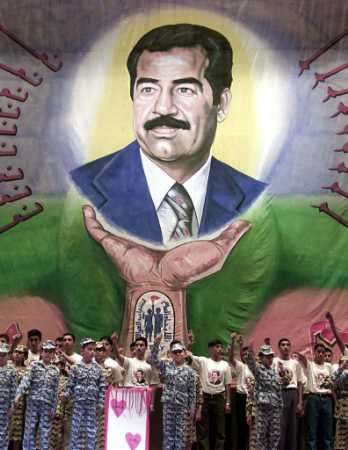
his days are numbered

March 20, 2003
The U.S. launches a second round of air strikes against Baghdad, and ground troops enter the country for the first time, crossing into southern Iraq from Kuwait. Defense Secretary Donald Rumsfeld claims that the initial phase of the war is mild compared to what it to come: "What will follow will not be a repeat of any other conflict. It will be of a force and a scope and a scale that has been beyond what we have seen before."

March 21, 2003
The major phase of the war begins with heavy aerial attacks on Baghdad and other cities. The campaign, publicized in advance by the Pentagon as an overwhelming barrage meant to instill "shock and awe," is in actuality more restrained.
bombing Bhagdad

March 24, 2003
Troops march within 60 miles of Baghdad. They encounter much stronger resistence from Iraqi soldiers and paramilitary fighters along the way, particularly in towns such as Nassiriya and Basra.

April 9, 2003
The fall of Baghdad: U.S. forces take control the city, but sporadic fighting continues throughout the capital.
Top

April 14, 2003
Major fighting in Iraq is declared over by the Pentagon, after U.S. forces take control of Tikrit , Saddam Hussein's birthplace and the last city to exhibit strong Iraqi resistence. Saddam Hussein's whereabouts remain unknown.

April 15, 2003
Gen. Jay Garner, appointed by the United States to run post-war Iraq until a new government is put in place, met with various Iraqi leaders to begin planning the new Iraqi federal government.

May 1, 2003
The U.S. declares an end to major combat operations.
the War is over!

May 12, 2003
A new civil administrator takes over in Iraq. Paul Bremer, a diplomat and former head of the counter-terrorism department at the State Department, replaces Jay Garner, who was seen as ineffective in stemming the continuing lawlessness and violence taking place throughout Iraq.
May 22, 2003
The UN Security Council approves a resolution lifting the economic sanctions against Iraq and supporting the U.S.-led administration in Iraq.


June 15, 2003
Operation Desert Scorpion launched, a military campaign meant to defeat organized Iraqi resistance against American troops. U.S. and British troops face continued attacks; about one American soldier has been killed per day since the end of combat was declared.
heroes

July 13, 2003
Iraq's interim governing council, composed of 25 Iraqis appointed by American and British officials, is inaugurated. The council has power to name ministers and will help draw up a new constitution for the country. The American administrator Paul Bremer, however, retain ultimate authority.
Paul Bremer,

July 17, 2003
U.S. combat deaths in Iraq reach 147, the same number of soldiers who died from hostile fire in the first Gulf War; 32 of those deaths occurred after May 1, the officially declared end of combat.

Thursday, July 31, 2003

US economy grows 2.4 percent in second quarter!!!!
U.S. Department of comerce

US economic growth shot to an annual pace of 2.4 percent in the second quarter, shattering sluggish expectations.

Defying forecasts for growth closer to 1.5 percent, the US economy gave the clearest sign yet it is shaking off Iraq war-inspired shock and gathering speed, with business investment finally back.

The return in business investment, a 52-year record surge in defense spending, robust consumer spending, and a red-hot housing market powered growth, early Commerce Department estimates showed.


AFP

Read the good news!

Wednesday, July 30, 2003

THE SEARCH FOR OSAMA
order="0" alt="Osama"
One day this past March, in Langley, Virginia, there was jubilation on a little-known thoroughfare called Bin Laden Lane. Analysts at the C.I.A.’s Counter-Terrorism Center, a dingy warren of gray metal desks marked by a custom-made street sign, were thrilled to learn that, seven thousand miles away, in Rawalpindi, Pakistan, colleagues from the agency had helped local authorities storm a private villa and capture Khalid Shaikh Mohammed, the man believed to be the third most important figure in the Al Qaeda terrorist organization.


by JANE MAYER


Read the whole article

Monday, July 28, 2003

His time is running short
Put Iraq Casualties In Proper Perspective
Folks, we're getting a daily death update out of Iraq, and we're hearing slogans like, "One a day," and "Our troops are being slaughtered," from the Democrats, as their willing accomplices in the press try to concoct this notion that the casualty rate over there is outrageous and intolerable.
14 people die everyday in pedestrian accidents.

The following statistics come from the Centers for Disease Control website:
On a daily basis, on average,
10 Americans die by drowning,
9 Americans die by fire in their homes.
14 Americans die by pedestrian accidents.
27 Americans die in falls.
On average, 50 Americans a day are murdered.
118 die in auto accidents,
25 people die from A.I.D.S. every day, on average.

Yesterday, two Americans died in battle in Iraq.

We are at war. The war isn't over, but it's time that somebody put some of this in perspective. The loss of a single member of the military is one too many, and what I'm saying here is not intended to minimize the losses that we've suffered, nor is it an attempt to defend Bush or our policy. What I want to do here is simply analyze the reporting and politicizing. There is a lack of perspective and proportion in the reporting of the casualties over there, and all you have to do to expose it, is examine some facts.

Rush

Read the whole article

Friday, July 25, 2003

Consider what has happened in the Near East since Sept. 11, 2001:

middle east

(1) In Afghanistan, the Taliban have been overthrown and a decent government has been installed.

(2) In Iraq, the Saddam Hussein regime has been overthrown, the dynasty has been destroyed and the possibility for a civilized form of governance exists for the first time in 30 years.

(3) In Iran, with dictatorships toppled to the east (Afghanistan) and the west (Iraq), popular resistance to the dictatorship of the mullahs has intensified.

(4) In Pakistan, once the sponsor and chief supporter of the Taliban, the government radically reversed course and became a leading American ally in the war on terror.

(5) In Saudi Arabia, where the presence of U.S. troops near the holy cities of Mecca and Medina deeply inflamed relations with many Muslims, the American military is leaving -- not in retreat or with apology but because it is no longer needed to protect Saudi Arabia from Hussein.

(6) Yemen, totally unhelpful to the United States after the attack on the USS Cole, has started cooperating in the war on terror.

(7) In the small, stable Gulf states, new alliances with the United States have been established.

(8) Kuwait's future is secure, the threat from Saddam Hussein having been eliminated.

(9) Jordan is secure, no longer having Iraq's tank armies and radical nationalist influence at its back.

(10) Syria has gone quiet, closing terrorist offices in Damascus and playing down its traditional anti-Americanism.

(11) Lebanon's southern frontier is quiet for the first time in years, as Hezbollah, reading the new strategic situation, has stopped cross-border attacks into Israel.

(12) Israeli-Palestinian peace negotiations have been restarted, a truce has been declared and a fledgling Palestinian leadership has been established that might actually be prepared to make a real peace with Israel.

Krauthammer


Bill defends G.W. !!??!?!
Bill shuts down the Democratic party and its nine candidates who have been hounding Bush about 16 words,
The last thing Bill wants is to have a Democrat win the white house!
For then, Hillary would not be able to run until 2008! Unacceptable.
slick Willie

KING: President, maybe I can get an area where you may disagree. Do you join, President Clinton, your fellow Democrats, in complaining about the portion of the State of the Union address that dealt with nuclear weaponry in Africa?

CLINTON: Well, I have a little different take on it, I think, than either side.

First of all, the White House said -- Mr. Fleischer said -- that on balance they probably shouldn't have put that comment in the speech. What happened, often happens. There was a disagreement between British intelligence and American intelligence. The president said it was British intelligence that said it. And then they said, well, maybe they shouldn't have put it in.

Let me tell you what I know. When I left office, there was a substantial amount of biological and chemical material unaccounted for. That is, at the end of the first Gulf War, we knew what he had. We knew what was destroyed in all the inspection processes and that was a lot. And then we bombed with the British for four days in 1998. We might have gotten it all; we might have gotten half of it; we might have gotten none of it. But we didn't know. So I thought it was prudent for the president to go to the U.N. and for the U.N. to say you got to let these inspectors in, and this time if you don't cooperate the penalty could be regime change, not just continued sanctions.

I mean, we're all more sensitive to any possible stocks of chemical and biological weapons. So there's a difference between British -- British intelligence still maintains that they think the nuclear story was true. I don't know what was true, what was false. I thought the White House did the right thing in just saying, Well, we probably shouldn't have said that. And I think we ought to focus on where we are and what the right thing to do for Iraq is now. That's what I think.


Larry king transcript

Read the whole transcript


Wednesday, July 23, 2003

Lawmakers' hush-hush talk broadcast live
Jackie Goldberg

Unbeknownst to them, a group of Assembly Democrats' private gab session about the state budget impasse -- including the political implications of accepting a Republican-driven spending plan without tax hikes -- was broadcast across the Capitol on Monday.
Part of the more than hourlong conversation rang out on a broadcast system available inside the Capitol and to subscribers outside the building -- including media and lobbyists. Alerted to the mix-up, Republican staffers recorded about 15 minutes of the conversation and later supplied a partial transcript to reporters.

The Assembly members at the meeting tried to guess which Senate Democrats would support a plan being crafted by Senate Republican leader Jim Brulte and Senate President Pro Tem John Burton, D-San Francisco.

By Alexa H. Bluth

Read the whole article

Sunday, July 20, 2003

RIAA nails 1,000 music-lovers in 'new Prohibition' jihad

downloaders down and out?

This signals a change of tactics for the RIAA: as now each individual file sharer is potentially responsible for thousands of dollars in damages. Once they were shielded by ISPs, but in the wake of the Verizon case, individuals are now exposed to direct intimidation. The RIAA is beside itself with glee: and boasted that a thousand music-lovers had already been busted.

The escalation in violence threatens to bring the US criminal justice system to an impasse: although the prison industry is already full to the brim, the RIAA's actions make new criminals out of tens of millions of ordinary US citizens. As Boycott-RIAA's founder Bill Evans notes, "there are more file-sharers than voters for either candidate at the last Presidential Election".


By Andrew Orlowski in San Francisco


Read the whole article before you go to jail